
Trust & Methodology Center
Rigorous transparency into our deterministic calculation engines, ephemeris algorithms, calendrical correlations, and cross-tradition mappings.
The 5-Tier Epistemological Truth Standard
OmniZodiac rigorously separates deterministic physical calculation from primary archaeological evidence, scholarly epigraphy, living cultural traditions and indigenous lineages, and modern editorial synthesis:
astronomy-engine v2.1.19 (MIT License), integer Julian Day Number (JDN) conversions via Meeus/Fliegel-Van Flandern, and Purple Mountain Observatory lunisolar tables.
Versioned Calculation Engines
| Engine / System | Version | Primary Astronomical / Historical Standard | Precision / Tolerance | Confidence Tier |
|---|---|---|---|---|
| Western Astrodynamics | v1.2.0 | Bretagnon & Francou VSOP87 / ELP2000-82 / Placidus semi-arc | < 0.01° rel. to JPL DE440 (Δ ≤ 0.0001°) | Tier A (Calculated) |
| Maya Calendrics | v2.0.0 | GMT 584283 Correlation / Meeus JDN / 260-day Tzolk'in | Exact integer day | Tier A (Conversion Arithmetic) / Tier C (GMT Correlation Model) |
| Egyptian Decans | v2.0.0 | 36 Ecliptic 10° Solar Divisions / Chaldean Planetary Order | < 0.01° solar arc | Tier A / Tier B |
| Chinese Lunisolar | v1.0.0 | 60-Year Ganzhi Cycle / Purple Mountain Observatory (1900–2100) | Exact LNY boundary | Tier A / Tier B |
| Pythagorean Numerology | v1.0.0 | 20th-Century Period Reduction Method (Campbell 1931) / Master Numbers 11, 22, 33 | Exact digit sum | Tier E (Modern Framework) / Tier A (Arithmetic) |
| OmniZodiac Compatibility Index | v2.1.0 | Harmonic Model (Element 40%, Modality 30%, Aspect 30%; Love includes Polarity 20%) | 50–98 bounded index | Tier C (Harmonic) |
| Oracle Fusion Combinator | v2.0.0 | 10-Dimension Cross-Tradition Semantic Resonance Ontology | Qualitative synthesis | Tier E (Synthesis) |
| Forecast Engine & Cosmic Clarity | v2.2.0 | VSOP87 Analytical Ephemeris / Solar House Convention / Aspect Harmonics | < 0.01° ecliptic / Exact integer seed | Tier A / Tier E |
| ReadingSnapshot Engine | v2.0.0 | Canonical JSON Normalization / Cryptographic SHA-256 Checksum | 256-bit hash match | Tier A (Deterministic) |
1. Western Tropical Astrology (VSOP87 & Placidus Trisection)
Western celestial coordinates are computed deterministically using astronomy-engine v2.1.19 (MIT License by Don Cross), implementing the Bretagnon & Francou (1988) VSOP87 analytical solution and Chapront-Touzé & Chapront (1983) ELP2000-82 lunar theory. Apparent geocentric solar ecliptic longitude determines exact Tropical sign cusps (0°–360°) with sub-arcminute physical accuracy (< 0.01°) relative to JPL DE440 standards, and internal computational determinism locked at Δ ≤ 0.0001°.
2. Maya Sacred Calendar (GMT 584283 Correlation)
Maya Tzolk'in and Haab' calculations utilize the scholarly correlation model Goodman-Martínez-Thompson (GMT 584283), supported by epigraphic consensus (Thompson 1950, FAMSI, Martin & Skidmore 2012) and high-resolution radiocarbon wiggle-matching of Tikal sapodilla lintels within 95% confidence intervals (Kennett et al. 2013). While the conversion arithmetic conditional on this correlation is deterministic (Tier A), the choice of correlation constant represents a scholarly model (Tier C). Dates are converted via the Fliegel-Van Flandern / Meeus JDN algorithm to map the 260-day sacred count (20 Nawales × 13 Tones), 365-day solar Haab' calendar, and 5-period Long Count, aligning with living ritual daykeeping documented among contemporary Highland Kʼicheʼ Ajqʼijabʼ (Barbara Tedlock 1982/1992).
3. Egyptian Decanal System (36 Decans & Chaldean Order)
Egyptian decan assignments distinguish ancient Middle Kingdom indigenous 36-star sidereal clocks (baktiu) from the later Hellenistic/Ptolemaic ecliptic division into 36 equal 10° solar sectors starting at 0° Aries, while indigenous Pharaonic decanal star clocks are referenced from Neugebauer & Parker (1960–1969). Planetary rulers follow the authentic Chaldean descending orbital sequence (Saturn, Jupiter, Mars, Sun, Venus, Mercury, Moon) recorded in Ptolemy's Tetrabiblos and Vettius Valens' Anthologies.
4. Chinese Lunisolar Sexagenary Cycle (Purple Mountain Data)
Chinese zodiac animal signs, fixed elements (Wood, Fire, Earth, Metal, Water), and Yin/Yang polarities map directly to the 60-year Lunisolar Sexagenary cycle (Ganzhi). Methodologically, we rigorously distinguish two distinct boundaries: the civil Lunar New Year (Chunjie, the astronomical new moon of the 1st lunar month derived from Purple Mountain Observatory data) and the traditional astrometric solar term Lichun (solar longitude λ = 315°), when the solar Ganzhi year pillar transitions in classical Chinese astronomy, avoiding any arbitrary January 1st assumptions.
5. Pythagorean Numerology (Period Reduction Method)
Life Path numbers are computed using the 20th-century Period Reduction Method (Campbell 1931 / Balliett 1908), reducing birth month, day, and year individually before summing. This distinguishes modern base-9 reduction and preserved Master Numbers 11, 22, and 33 from ancient Pythagorean harmonic ratios (Tetractys and monochord intervals).
6. OmniZodiac Compatibility Index (Harmonic Model v2.1.0)
Our compatibility scores are computed via a symmetric, deterministic astrological harmonic model codified in CompatibilitySpec v2.1.0. Overall compatibility synthesizes Element Synergy (40%), Modality Dynamics (30%), and Harmonic Aspect Angle (30%), with scores strictly bounded in [50, 98]. Romantic synergy incorporates Polarity Alignment (20%). Published percentages represent an astrological compatibility index, not an empirical guarantee or prediction of relationship outcome.
S_overall = round(clamp(0.40 × E + 0.30 × M + 0.30 × A, 50, 98)), where E, M, and A are deterministic astrological factors in [50, 98]. Symmetry Invariant: S(A, B) = S(B, A) across all 144 sign combinations. Version v2.1.0 forms the single source of truth across algorithms, UI components, PDF exports, and structured data. 7. Deterministic Forecast Engine, Cosmic Clarity & Harmonic Numbers (Engine v2.2.0)
OmniZodiac's multi-period forecast engine synthesizes analytical planetary ephemeris (VSOP87) with the classical Solar House system across 9 distinct forecast horizons: Daily, Tomorrow, Weekly, Monthly, Yearly, Love, Career, Money, and Wellness. Our engine strictly separates calculated celestial motions from interpretive contemplation, guaranteeing zero fatalistic predictions and zero speculative claims.
Primary Archaeological & Documentary Evidence
Every traditional astrological system represented on OmniZodiac is grounded in verified documentary and archaeological artifacts. Below are the primary historical manuscripts, stone stelae, and architectural ephemeris alignments that inform our calculation algorithms.
Documented Ancient Ephemeris Records
Primary source documentation preserved in major open-access academic and museum collections.

Page 24 of the Dresden Codex detailing the 584-day synodic cycle of Venus (Chak Ek') and correlation with the 260-day Tzolk'in sacred calendar.
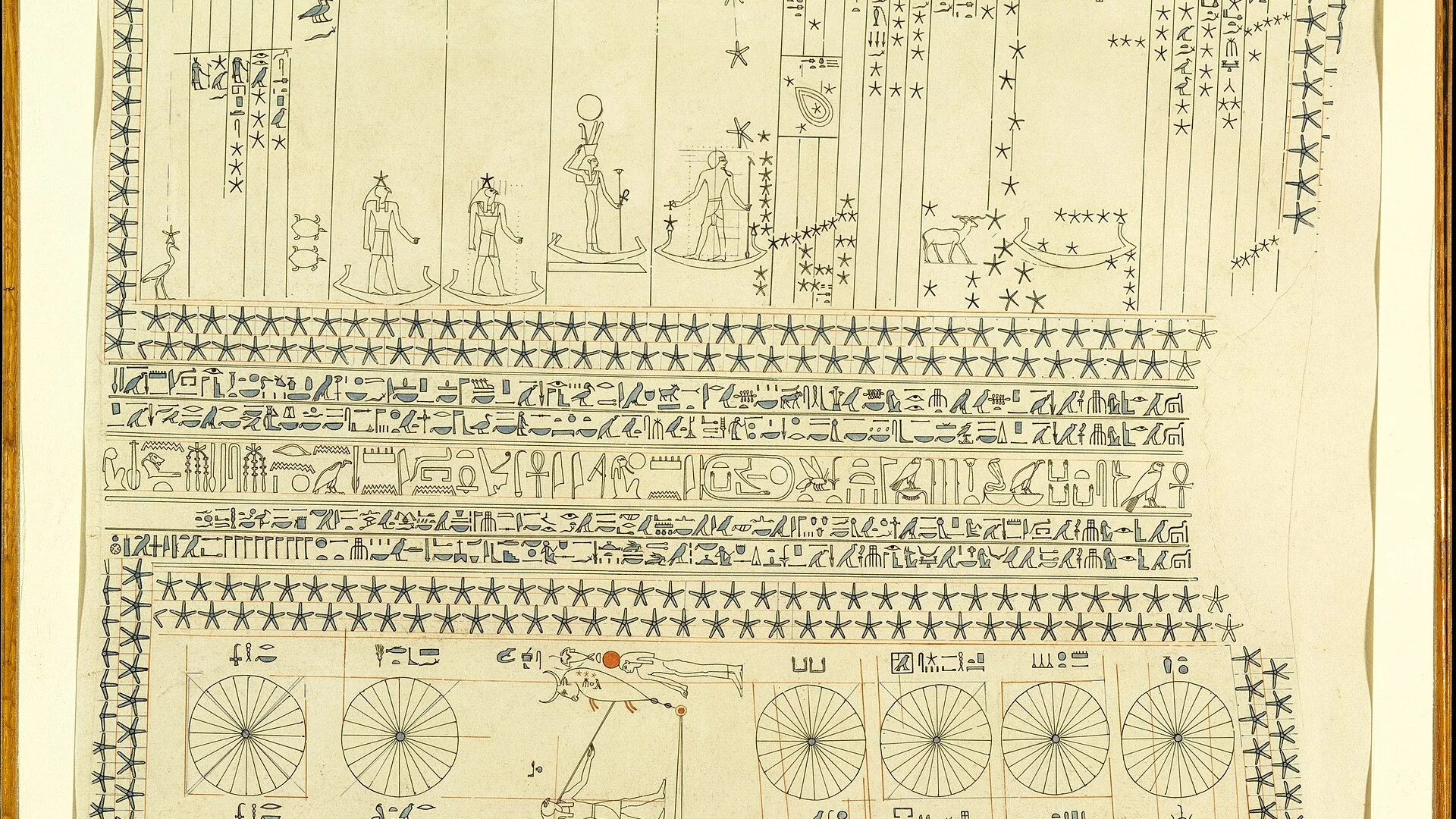
Astronomical ceiling in the Tomb of Senenmut (TT353, c. 1473 BCE), the oldest known comprehensive star map displaying the 36 decans, Orion (Sah), Sirius (Sopdet), and lunar calendar circles.

The Dunhuang Star Chart (c. 700 CE, British Library Or.8210/S.3326), the world's earliest surviving comprehensive manuscript star atlas, plotting 1,339 stars across 257 asterisms and 28 Lunar Mansions (Xiu).
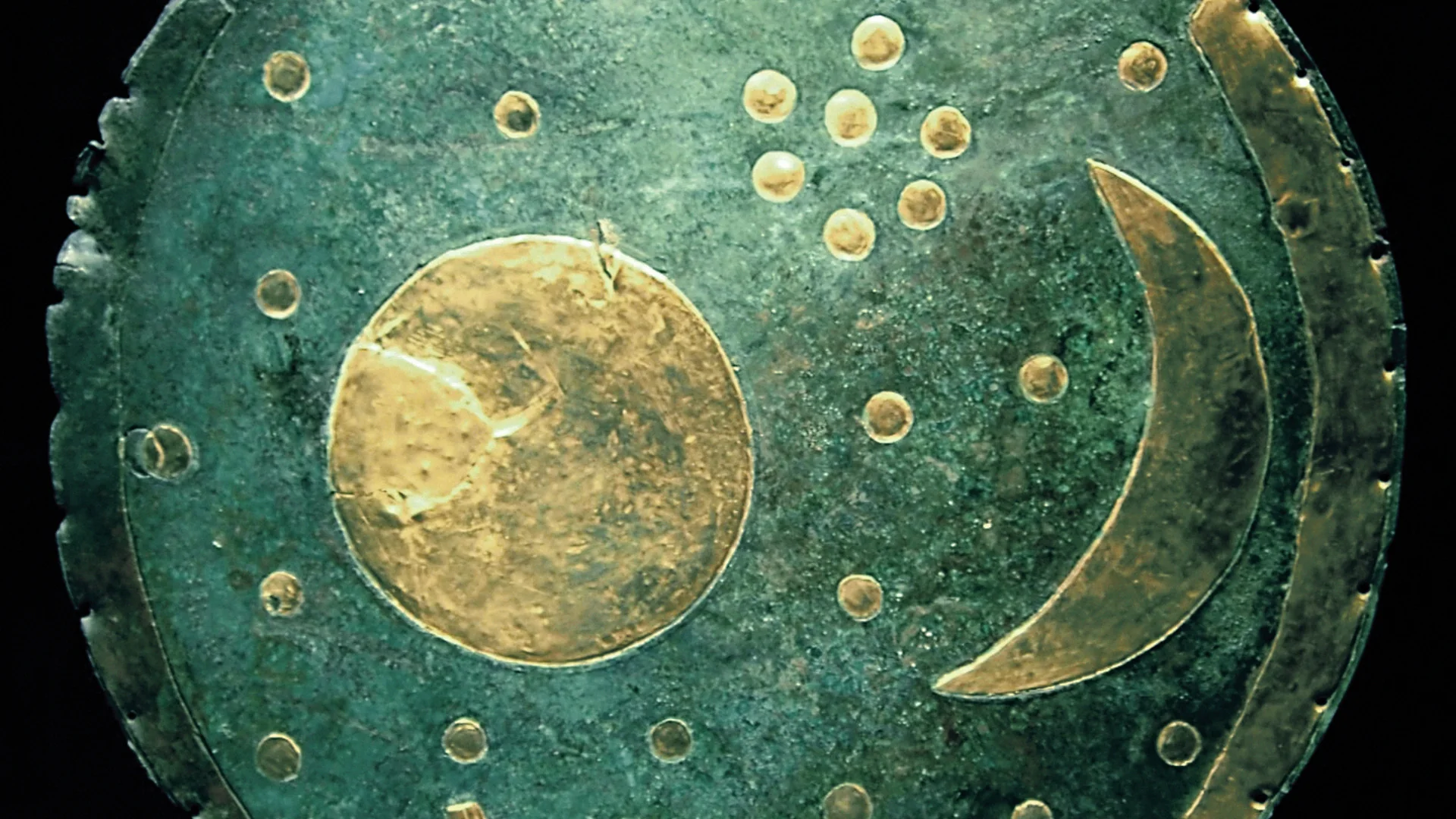
The Nebra Sky Disk (c. 1600 BCE, Halle State Museum), a 30 cm bronze disk with gold inlays depicting the Sun/full Moon, crescent Moon, Pleiades star cluster (7 gold dots), and horizon angle arcs matching the 82° annual solar azimuth shift.
Authoritative Primary Sources & Research Bibliography
OmniZodiac calculation models and cross-tradition taxonomies derive directly from published academic monographs, ephemerides, and primary epigraphic collections. Below is the crawlable reference bibliography:
Bretagnon, P. & Francou, G. (1988). Planetary theories in rectangular and spherical variables: VSOP87 solutions. Astronomy and Astrophysics, 202(1–2), 309–315.
Chapront-Touzé, M. & Chapront, J. (1983). The lunar ephemeris ELP 2000. Astronomy and Astrophysics, 124(1), 50–62.
Meeus, J. (1998). Astronomical Algorithms (2nd ed.). Willmann-Bell, Inc.
Cross, D. (2020). Astronomy Engine: Precise positional astronomy algorithms in C, C#, Python, and JavaScript. MIT License.
Eggert, P., & Olson, A. D. (2026). Sources for time zone and daylight saving time data. Internet Assigned Numbers Authority.
Ptolemy, C. (1940). Tetrabiblos (F. E. Robbins, Ed. & Trans.). Harvard University Press (Loeb Classical Library No. 435).
Valens, V. (1986). Vettii Valentis Antiocheni Anthologiarum libri novem (D. Pingree, Ed.). B. G. Teubner.
de Titis, P. (1657). Primum Mobile: Complectens theoriis et canonibus extrinsecis in tabulis directoriis. Padua.
Sächsische Landesbibliothek – Staats- und Universitätsbibliothek Dresden. (n.d.). Codex Dresdensis (Mscr. Dresd. Ch. 1). Dresden, Germany.
Sharer, R. J. (1990). Quiriguá: A Classic Maya Center and Its Sculptures. Carolina Academic Press.
Fash, B. W. (1992). Late Classic Maya stone sculpture from Copán, Honduras. In Classic Maya Political History (pp. 204–235). Cambridge University Press.
Aveni, A. F., Gibbs, S. L., & Hartung, H. (1975). The Caracol, the observatory at Chichen Itza: An astronomical analysis. Science, 188(4192), 977–985.
Precision, Edge Cases & Known Limitations
- Polar Latitudes (|lat| ≥ 66.56°): Under extreme arctic/antarctic coordinates where celestial semi-arcs do not intersect the horizon, our Placidus house engine automatically and gracefully falls back to Equal House division without layout shifts or NaN values.
- Missing Birth Time: When birth time is unspecified, our system calculates planetary longitudes for 12:00 UTC and computes a rigorous 24-hour Moon span to qualify whether the Moon changed signs during the calendar date. Authoritative Ascendant (Rising sign), Midheaven (MC), and house cusps are omitted entirely to prevent fabricating speculative angles.
- Missing or Ambiguous Birth Location: When location is unspecified, local horizon angles (Rising/MC/houses) are omitted entirely (never defaulted to 0° UTC / Greenwich). Planetary placements are computed in the geocentric ecliptic reference frame with an explicit geocentric advisory.
- Historical Timezones & Daylight Saving Time: Dates and coordinates are resolved via the canonical IANA timezone database using native
Intl.DateTimeFormatUTC offset resolution, supporting historical war time (WWII War Time, British Double Summer Time), non-hourly timezones (e.g., India +5:30, Nepal +5:45), and seasonal DST transitions without naive longitude approximations. Birth dates preceding the standardization of civil railway time zones (e.g., pre-1883 in the US, pre-1880 in Britain, pre-1893 in Germany) are classified as historical Local Mean Time (LMT) and transparently flagged with an advisory notice. - Zero Scientific Prediction Claims: OmniZodiac does not provide medical diagnoses, legal counsel, financial forecasts, or fatalistic mortality predictions.
Corrections Policy & Ephemeral Privacy
We invite academic, astronomical, and user scrutiny. If you discover a mathematical discrepancy or historical error, please review our Corrections Policy and submit a report for prompt verification.
100% Client-Side & Strictly Browser-Local Privacy: All birth data calculations execute 100% locally in your client device browser (with zero server processing, zero serverless function endpoints, and zero remote logging of personal coordinates or birth times). Personal birth details are never saved, stored, or transmitted.
Geographical Data & Timezone Reference (GeoNames CC BY 4.0)
Worldwide city coordinates, administrative subdivisions, population ranks, and canonical IANA timezone associations are derived from the GeoNames Geographical Database under the Creative Commons Attribution 4.0 International License (CC BY 4.0).
All geospatial search indices and historical timezone resolution calculations run 100% locally and offline in the user's browser without sending typed queries or birth locations to external geocoding servers.
Algorithmic astronomical and calendrical computations (VSOP87, ELP2000, topocentric house cusps, Maya Long Count GMT 584283 correlation model, Chinese Ganzhi, modern Pythagorean reduction). Fully deterministic, client-side only, bit-for-bit reproducible.
Calculations executed client-side via astronomy-engine v2.1.19 (VSOP87 / ELP2000-82) with zero server birth data transmission. Mathematical algorithms adhere to peer-reviewed astronomical standards.
This page was produced via deterministic algorithms and literature synthesis without an independent external human review record.