

Scope, Epistemological Stratification & Privacy
OmniZodiac delivers deterministic astronomical computation paired with transparent historical documentation. To maintain absolute academic and scientific integrity, our Egyptian Decan engine enforces a rigorous separation between verified celestial mechanics, archaeological primary evidence, classical Hellenistic adaptations, and modern interpretive synthesis.
VSOP87 Astrometry
Deterministic geocentric solar coordinates computed locally via analytical series expansions. Ephemeral, private, zero telemetry.
Nilotic Star Registers
Epigraphic evidence from Middle Kingdom coffin lids (Asyut) and New Kingdom royal tomb ceilings (Senenmut TT353, Seti I KV17).
10° Ecliptic & Chaldean Order
Ptolemaic Alexandrian mapping of 36 decans onto the 360° solar zodiac, governed by the 7 classical wanderers in speed order.
Archetypal Psychology
Modern reflective characterizations badged transparently for introspection; strictly devoid of 1990s pseudo-Egyptian deity tables.
Client-Side Privacy Guarantee
astronomy-engine. Zero birth dates, timestamps, or geographic coordinates are ever transmitted to external servers or logged in databases.
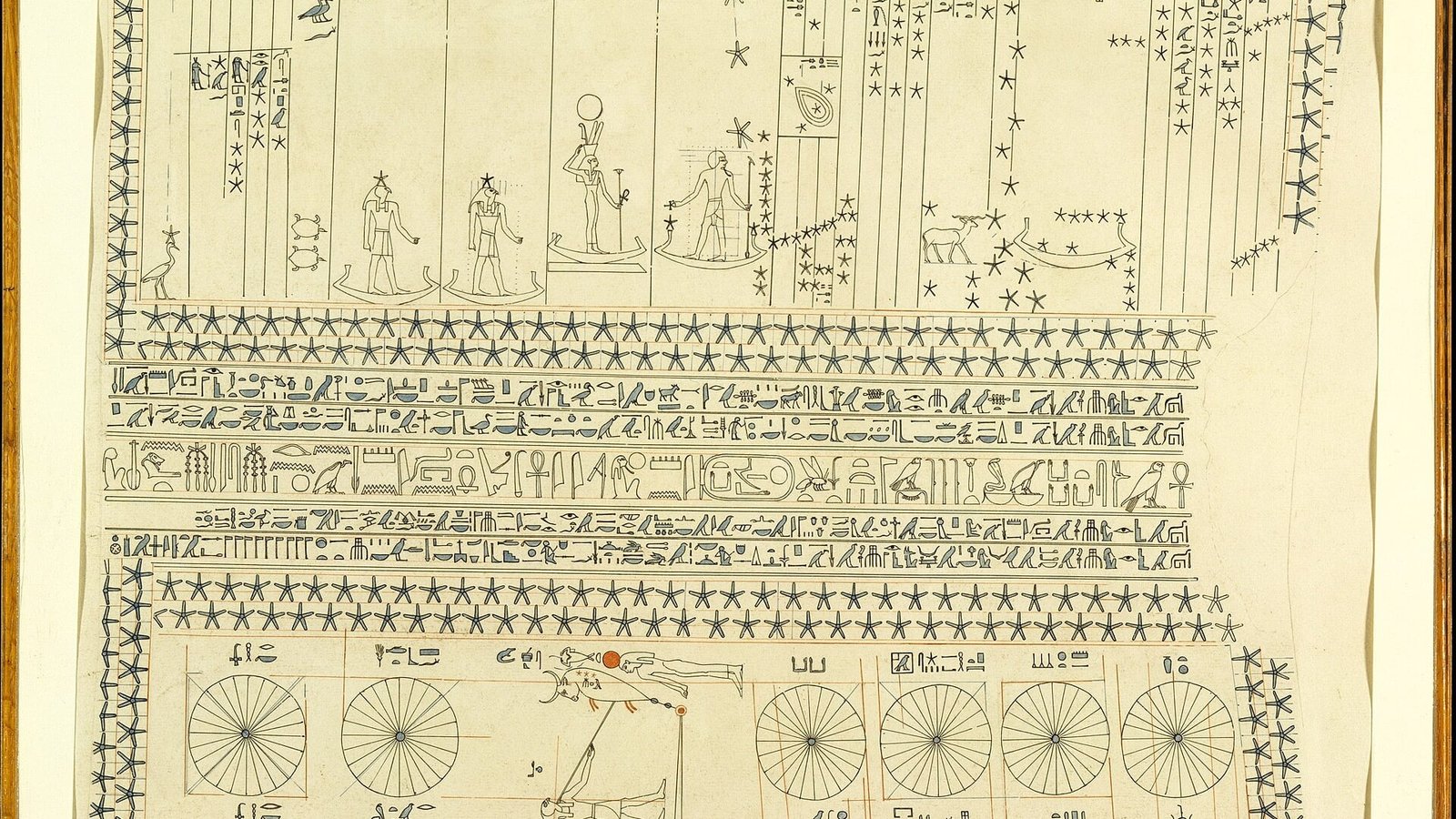
The Nilotic Astronomical Archive
Senenmut TT353 (c. 1473 BCE) & The Dendera Circular Planisphere (c. 50 BCE)
Neugebauer & Parker (1960–1969), Egyptian Astronomical Texts III; Musée du Louvre Inv. D 38
The Four-Layer Historical Architecture
The decans underwent three millennia of evolution from Nile flood timekeepers to Hellenistic astrological faces. Conflating these eras produces pseudo-historical distortion. OmniZodiac stratifies the tradition into four immutable layers:
Nilotic Stellar Clocks & The 36 Bꜣktjw
Originally, Egyptian decans (bꜣktjw, "the working stars") were thirty-six distinct asterisms whose heliacal rising occurred at 10-day intervals along the southern celestial belt. Documented on diagonal star tables on Asyut coffin lids and astronomical ceilings (Senenmut TT353, Seti I KV17), decans served exclusively as nocturnal timekeepers to divide the night into 12 equal hours and synchronize agricultural rites with the annual Nile inundation (Akhet), signaled by the heliacal rising of Sirius (Sopdet).
Hellenistic 10° Ecliptic Synthesis
Following Alexander's conquest and the founding of the Ptolemaic dynasty, Greek and Egyptian astronomers in Alexandria synthesized the 36 indigenous stellar asterisms with the 12-sign, 360° Babylonian/Hellenistic solar ecliptic. Each 30° zodiacal constellation was bisected into three 10° arcs ("faces" or *prosōpa*). The physical apotheosis of this synthesis is immortalized in the sandstone relief of the Dendera Circular Planisphere (c. 50 BCE, Louvre D 38), where 36 decanal figures encircle the 12 signs.
Chaldean Planetary Governors
In classical Hellenistic and Roman astrology (documented by Vettius Valens and Firmicus Maternus), each 10° decan was assigned a planetary ruler according to the ancient Chaldean sequence of decreasing planetary velocity: Saturn → Jupiter → Mars → Sun → Venus → Mercury → Moon. Beginning at 0° Aries with Mars, this seven-planet sequence repeats across the 36 decans.
Modern Archetypal & Psychological Reflection
In modern introspective astrology and hermetic tarot traditions (such as the Golden Dawn's mapping of decans to the Minor Arcana cards 2 through 10), decanal degrees serve as symbolic mirrors for psychological themes, personal growth, and creative literature. OmniZodiac transparently identifies all such material with our ✦ Modern Interpretive Synthesis ✦ badge, ensuring users clearly distinguish ancient funerary timekeeping from modern psychological reflection.
Celestial Coordinate Computation & Mathematical Model
Every decan designation begins with the high-precision calculation of apparent tropical solar longitude ($\lambda$). OmniZodiac utilizes the analytical VSOP87 (Variations Séculaires des Orbites Planétaires) planetary theory via astronomy-engine.
1. Solar Longitude Formula (λ)
Given civil birth year Y, month M, day D, and UTC instant T_UTC, we evaluate the barycentric geocentric position of the Sun corrected for light-travel time and nutation in longitude:
λ = SunLongitude(T_UTC) mod 360°, &quad; λ ∈ [0°, 360°) 2. Global Decan Index Mapping (D)
The 360° tropical ecliptic is divided into exactly thirty-six contiguous, non-overlapping 10° arcs. The global decan index D ∈ {1, 2, ..., 36} is computed via the floor function:
D = floor(λ / 10°) + 1 3. Host Zodiac Sign & Local Position
The host tropical zodiac sign index S ∈ {0, 1, ..., 11} and relative degree within the sign θ ∈ [0°, 30°) are derived as:
S = floor(λ / 30°), &quad; θ = λ - (30° × S) The local decan position P ∈ {1, 2, 3} (1st, 2nd, or 3rd decan of the host sign) is:
P = floor(θ / 10°) + 1 4. Boundary Transition Rules
Decan intervals are defined as strict half-open intervals [D_start, D_end):
| Decan Index | Host Sign | Position | Ecliptic Range (λ) | Boundary Evaluation |
|---|---|---|---|---|
| Decan 1 | Aries | 1st Decan | 0.0000° ≤ λ < 10.0000° | At 0.0000° (Vernal Equinox Gate) |
| Decan 2 | Aries | 2nd Decan | 10.0000° ≤ λ < 20.0000° | At exactly 10.0000°, transitions to Decan 2 |
| Decan 10 | Cancer | 1st Decan | 90.0000° ≤ λ < 100.0000° | At 90.0000° (Summer Solstice Gate) |
| Decan 19 | Libra | 1st Decan | 180.0000° ≤ λ < 190.0000° | At 180.0000° (Autumnal Equinox Gate) |
| Decan 28 | Capricorn | 1st Decan | 270.0000° ≤ λ < 280.0000° | At 270.0000° (Winter Solstice Gate) |
| Decan 36 | Pisces | 3rd Decan | 350.0000° ≤ λ < 360.0000° | At 360.0000° ≡ 0.0000°, cleanly wraps to Decan 1 |
5. Exact Boundary Ingress Determination
When determining the exact millisecond of decanal ingress for a given calendar day, OmniZodiac executes a bounded root-finding bisection algorithm on Δλ(t) = λ(t) - (D × 10°) with a convergence tolerance of ε < 0.0001° (approx. 0.36 arcseconds), preventing boundary flicker across timezone shifts.
Chaldean Planetary Governor Sequence & Mathematical Proof
The Hellenistic decanal lordship assigns one of the seven traditional visible planets to each decan in descending order of geocentric orbital period (apparent velocity across the zodiacal background):
Algorithmic Formulation
Because Aries is traditionally governed by Mars (its domicile lord), the sequence commences at Mars for Decan 1 (Aries 1st decan). The recurring 7-planet governor array is:
GovernorCycle = [Mars, Sun, Venus, Mercury, Moon, Saturn, Jupiter] For any decan index D ∈ {1, 2, ..., 36}, the assigned planetary governor is:
Governor(D) = GovernorCycle[(D - 1) mod 7] Cyclic Closure Proof (36 mod 7 = 1)
The thirty-six decans complete five full iterations of the seven classical planets, plus one remainder:
36 = (5 × 7) + 1 ⇒ 36 ≡ 1 (mod 7) Consequently, Decan 36 (Pisces 3rd decan, 350°–360°) is governed by Mars (index 0). When the sun crosses the vernal equinox at 0° Aries, it enters Decan 1 (Aries 1st decan, 0°–10°), which is also governed by Mars. This mathematical consequence was viewed in Hellenistic antiquity as a cosmic design: the fiery martial impetus ends the winter zodiac cycle and re-ignites the spring initiation without interruption.
Scholarly Refutation of Pseudo-Egyptian "God-Sign" Tables
A pervasive internet myth claims that ancient Egyptians possessed a 12-sign zodiac where individuals are "born under the sign of Bastet, Osiris, Anubis, Horus, or Sekhmet." OmniZodiac actively refutes and excludes this commercial fabrication.
The 1990s Pop-Culture Myth
- Invented tables published in 1990s tabloid magazines and gift books.
- Arbitrary Gregorian calendar spans assigned to famous deities (e.g. "Bastet: July 14–28, Sept 23–27, Oct 3–17").
- Claims ancient Egyptians used 12 anthropomorphic animal gods as sun signs.
- Zero archaeological, papyrological, or temple epigraphic foundation.
The Authentic Egyptological Record
- Ancient Egyptians used 36 decanal star groups (bꜣktjw) along the ecliptic and southern declination belts.
- Decanal names were strictly asterisms: Kenmet, Sopdet (Sirius), Sah (Orion's belt), Khnum.
- The 36 decanal protective spirits were recorded on monolithic shrines like the Naos of the Decades (30th Dynasty, c. 380 BCE).
- OmniZodiac uses 100% authentic transliterated hieroglyphic names and documented astronomical positions.
Academic Integrity Commitment
Primary Sources, Philological Corpora & Academic Citations
OmniZodiac's Egyptian decan database is calibrated against peer-reviewed Egyptological scholarship and high-resolution archaeological documentation:
Egyptian Astronomical Texts (Vols. I–III: The Early Decans, The Ramesside Star Clocks, Decans and Constellations).
Brown University Press & Lund Humphries. Table 5 in Volume III provides the direct concordance for our 36 decanal transliterations, variant hieroglyphic spellings, and star catalog numbers.
The Naos of the Decades: Undiscovered Gems of Ancient Egyptian Astronomy.
Oxford Centre for Maritime Archaeology (Monograph 3). Primary epigraphic reconstruction of the 30th Dynasty monolithic shrine discovered at submerged Thonis-Heracleion, detailing decanal cosmological powers.
Altägyptische Sternuhren (OLA 62) & Lexikon der ägyptischen Götter und Götterbezeichnungen (LGG).
Peeters Publishers. Rigorous philological breakdown of diagonal star clocks and tutelary deity associations across New Kingdom and Graeco-Roman temples.
Ancient Egyptian Astronomical Database (AEAD).
McMaster University. Comprehensive catalog of all surviving Egyptian coffin lid star tables and royal ceiling registers.
OmniZodiac Editorial & Astronomical Research Staff. (2026). Egyptian Decan Calculation Methodology: Ecliptic Astronomy, VSOP87 Astrometry, and Nilotic Star Clock History. OmniZodiac. https://omnizodiac.com/egyptian-decan/methodology/ Explore Egyptian Astronomy & Cross-Tradition Synthesis
Navigate across our interactive birth calculators, historical monographs, 36-decan catalogs, and multi-system fusion engine: