How does the Chinese sexagenary Ganzhi cycle combine the 10 Heavenly Stems and 12 Earthly Branches across 60 years?
The 60 Ganzhi cycle is one of the world's oldest continuous calendrical systems, interleaving lunisolar cycles with Wuxing elements and animal branches.

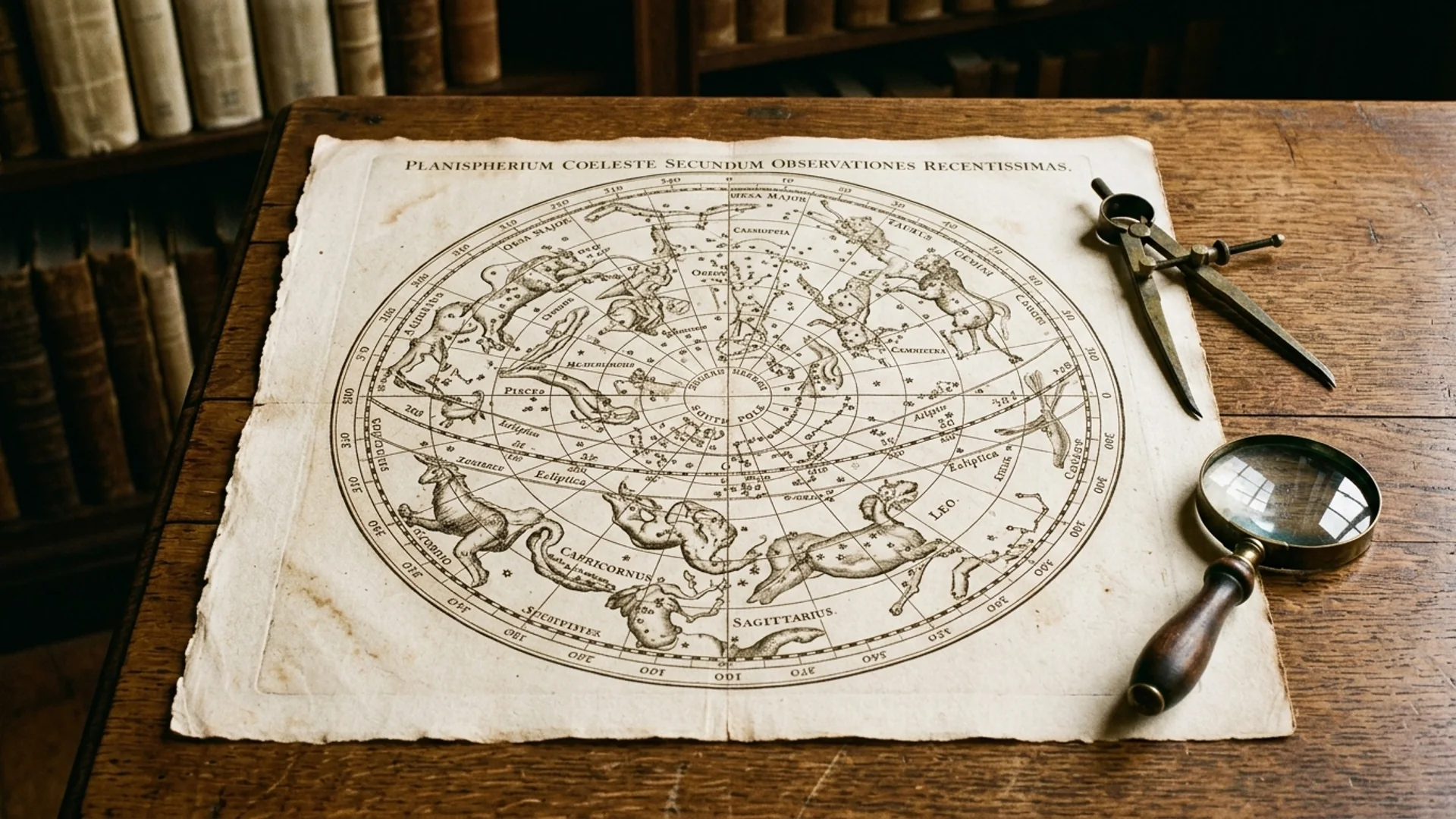
The Dunhuang Star Chart (c. 700 CE, British Library Or.8210/S.3326), the world's earliest surviving comprehensive manuscript star atlas, plotting 1,339 stars across 257 asterisms and 28 Lunar Mansions (Xiu).
Comparative Solar, Lunar & Lunisolar Timekeeping
Harmonizing tropical solar years, synodic lunations, Maya Tzolk'in/Haab' Calendar Rounds, and Chinese Ganzhi cycles. • Modeled after Comparative Multi-Register Planispheres (Francesco Bianchini & Johannes Kepler's Tabulae Rudolphinae, 1627 CE)
Astronomical Basis: Earth orbital return to Vernal Equinox (0° Aries)
Seasonal Reconciliation: Leap year intercalary day added every 4 years (excluding century years not divisible by 400)
Astronomical Basis: 12 complete lunation cycles from New Moon to New Moon
Seasonal Reconciliation: Drifts ~10.88 days per tropical solar year; rotates backward through all seasons every 33 solar years
Astronomical Basis: Harmonization of solar seasons and lunar months within 19 solar orbits
Seasonal Reconciliation: 7 intercalary embolismic lunar months inserted across the 19-year cycle (years 3, 6, 8, 11, 14, 17, 19)
Astronomical Basis: Interlocking 260-day sacred Tzolk'in (13 tones x 20 signs) and 365-day civil Haab' (18 x 20 + 5 Wayeb')
Seasonal Reconciliation: Permutational congruence without leap days; anchored to 13.0.0.0.0 Long Count creation era by GMT 584283
Astronomical Basis: Lunisolar months synchronized with 24 Solar Terms (Jieqi) based on 15° solar longitude increments
Seasonal Reconciliation: Intercalary leap month (Runyue) inserted whenever a lunar month lacks a major Zhongqi solar term
Chinese traditional astronomy represents one of the longest continuous traditions of state-supported observational science in human history. Unlike purely solar calendars (such as the Western Gregorian) or purely lunar calendars (such as the Islamic Hijri), the traditional Chinese calendar is lunisolar (Yin-Yang Li).
It mathematically synchronizes the monthly phases of the Moon (the synodic month of 29.53 days) with the agricultural seasons governed by the Sun’s tropical orbit (the solar year of 365.2422 days), organized through the elegant 60-year Sexagenary Cycle (Ganzhi).
+-----------------------------------------------------------------------------+
|                      THE CHINESE LUNISOLAR ARCHITECTURE                     |
|                                                                             |
|  1. THE 10 HEAVENLY STEMS (Tian Gan) • 5 Elements × Yin/Yang Polarities     |
|     Jia (Yang Wood), Yi (Yin Wood), Bing (Yang Fire), Ding (Yin Fire),      |
|     Wu (Yang Earth), Ji (Yin Earth), Geng (Yang Metal), Xin (Yin Metal),    |
|     Ren (Yang Water), Gui (Yin Water).                                      |
|                                                                             |
|  2. THE 12 EARTHLY BRANCHES (Di Zhi) • 12 Zodiac Animals                    |
|     Zi (Rat), Chou (Ox), Yin (Tiger), Mao (Rabbit), Chen (Dragon),          |
|     Si (Snake), Wu (Horse), Wei (Goat), Shen (Monkey), You (Rooster),       |
|     Xu (Dog), Hai (Pig).                                                    |
|                                                                             |
|  3. THE 60-YEAR GANZHI COMBINATION (LCM of 10 and 12 = 60)                  |
|     Starting with Jia-Zi (Wood Rat) through Gui-Hai (Water Pig).            |
+-----------------------------------------------------------------------------+
1. Ancient Archaeological Provenance
The Ganzhi cyclical notation is not a modern mythological invention; it is attested in the earliest surviving written records of East Asian civilization:
+--------------------------------------------------------------------+
|                  PRIMARY ARCHAEOLOGICAL ARTIFACTS                  |
|                                                                    |
|  1. SHANG ORACLE BONES (c. 1300–1046 BCE, Anyang / Yinxu)          |
|     • Complete 60-day Ganzhi tables inscribed on ox scapulae and   |
|       turtle plastrons, used for royal astronomical divination.    |
|                                                                    |
|  2. DUNHUANG STAR ATLAS (c. 700 CE, Tang Dynasty, Mogao Caves)     |
|     • Preserved in British Library (MS Or.8210/S.3326).            |
|     • Oldest surviving manuscript star atlas in the world,         |
|       mapping 1,339 stars in 257 asterisms on cylindrical projection|
|                                                                    |
|  3. SU SONG'S KAIFENG CLOCK TOWER (1092 CE, Song Dynasty)          |
|     • Monumental 12-meter water-driven astronomical clock tower     |
|       featuring an automated mechanical armillary sphere and globe. |
+--------------------------------------------------------------------+
2. The 24 Solar Terms (Jie Qi)
To prevent the lunar months from drifting out of alignment with the agricultural seasons, ancient Chinese astronomers partitioned the 360° solar ecliptic into 24 equal segments of 15° each, known as the 24 Solar Terms (Jie Qi):
$$\text{Solar Term Interval} = 360^\circ / 24 = 15^\circ \text{ Solar Longitude}$$
- Lichun (立春 / Start of Spring) occurs at exact solar longitude $315^\circ$ (typically 3–5 February). In authentic Chinese four-pillar astrology (BaZi), Lichun—not the lunar Chinese New Year day—marks the precise astronomical start of the new zodiacal year animal.
- Chunfen (春分 / Vernal Equinox) at $0^\circ$.
- Xiazhi (夏至 / Summer Solstice) at $90^\circ$.
- Qiufen (秋分 / Autumn Equinox) at $180^\circ$.
- Dongzhi (冬至 / Winter Solstice) at $270^\circ$.
The Intercalary Leap Month (Runyue) Rule
Because 12 lunar months total approximately 354.36 days (10.88 days shorter than a tropical solar year), an extra intercalary leap month (Runyue) is inserted approximately seven times in nineteen years (the Metonic relationship).
By traditional mathematical convention codified in the Ming Dynasty Datong calendar and Qing Dynasty Shixian calendar, a leap month is inserted into the year after the first month that does not contain a major mid-term (Zhongqi).
3. The Four Pillars of Destiny (BaZi)
In traditional Chinese astrology, an individual’s cosmic blueprint comprises not just the birth year animal, but Four Pillars (Year, Month, Day, Hour), each represented by a Heavenly Stem and an Earthly Branch:
$$\text{BaZi Matrix} = (\text{Year Stem/Branch}) + (\text{Month Stem/Branch}) + (\text{Day Stem/Branch}) + (\text{Hour Stem/Branch})$$
- Year Pillar: Ancestral heritage, grandparents, public persona.
- Month Pillar: Parents, upbringing, career environment (anchored to the 24 Solar Terms).
- Day Pillar (The Day Master): The core inner self, personal identity, spouse.
- Hour Pillar: Children, later life aspirations, subconscious drives.
4. The Five Elements (Wuxing) Generative and Control Cycles
In Chinese cosmology, all energetic manifestations in the universe are classified into Five Phases / Elements (Wuxing):
          [ GENERATIVE CREATIVE CYCLE ]           [ CONTROLLING RESTRAINING CYCLE ]
          Wood feeds Fire                         Wood parts Earth
          Fire creates Earth (ash)                Earth dams Water
          Earth bears Metal                       Water extinguishes Fire
          Metal enriches Water                    Fire melts Metal
          Water nourishes Wood                    Metal chops Wood
Explore your complete Chinese lunisolar zodiac animal, fixed element, and 60-year Ganzhi placement in our Chinese Zodiac Hub and synthesize it with your Western natal chart in OmniZodiac Fusion.
Historical Sources & Epistemological Citations
OmniZodiac strictly documents astronomical, calendrical, and historical sources. Calculations follow deterministic formulas (VSOP87, GMT 584283, Chinese lunisolar ephemeris) while interpretive models remain tools for personal reflection.
- Needham, Joseph. Science and Civilisation in China, Volume 3: Mathematics and the Sciences of the Heavens and the Earth. Cambridge University Press, 1959.
- Aslaksen, Helmer. The Mathematics of the Chinese Calendar. National University of Singapore, 2010.
- Whitfield, Susan. The Silk Road: Trade, Travel, War and Faith. British Library, 2004 (Dunhuang Star Atlas S.3326).
- Ho Peng Yoke. Li, Qi and Shu: An Introduction to Science and Civilization in China. Dover Publications, 2000.
- Sun, Xiaochun & Jacob Kistemaker. The Chinese Sky During the Han: Constellating Stars and Society. Brill, 1997.