What is a composite chart, and how does calculating mathematical midpoints between two natal placements create a third relational entity?
While synastry reveals how two people interact, the composite chart uses mathematical planetary midpoints to reveal the shared destiny and purpose of the partnership itself.
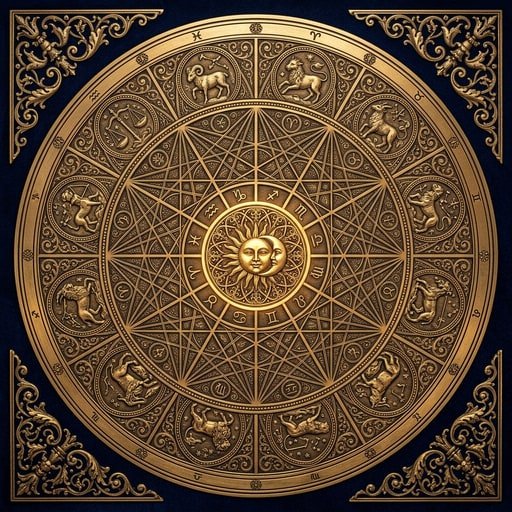
Sacred Ecliptic Geometry & Ptolemaic Aspects
The 360° celestial circle partitioned into 4 elemental triplicities, 3 energetic modalities, and harmonic angular chords. • Modeled after Andreas Cellarius' Harmonia Macrocosmica (1660 CE, Planisphaerium Stellatum)
While synastry evaluates how two independent individuals interact on a personal level, the Composite Chart calculates the mathematical midpoints between two birth charts, generating an entirely new, single birth chart for the relationship itself as a third entity.
When two people form a sustained partnership—whether romantic, creative, or business—their union develops its own unique emotional climate, shared challenges, social presentation, and developmental destiny that transcends the individual preferences of either partner.
+-----------------------------------------------------------------------------+
|                     SYNASTRY VS COMPOSITE CHART CONTRAST                    |
|                                                                             |
|  FEATURE               SYNASTRY                     COMPOSITE CHART         |
|  Core Subject          Two separate individuals     The relationship entity |
|  Mathematical Model    Bi-wheel angular overlays    Mathematical midpoints  |
|  Primary Question      "How do I experience you?"   "What is our shared life?"|
|  Operational Arena     Interpersonal chemistry      Joint purpose & destiny |
|  Longevity Scope       Initial attraction & spark   Long-term systemic bond |
+-----------------------------------------------------------------------------+
1. The Mathematical Mechanics of Midpoint Calculation
The Composite Chart is calculated by finding the geometrical midpoint along the shorter arc of the ecliptic between each matching celestial coordinate in Chart A and Chart B:
Midpoint = (λA + λB) / 2 (adjusted to the shortest arc ≤ 180°)
The Near-Arc vs Far-Arc Dilemma
Because a circle contains 360°, any two points define two midpoints separated by 180°: the near-arc midpoint (the shorter distance) and the far-arc midpoint (the longer distance). Standard composite algorithms always select the near-arc. However, when two planets are exactly in 180° opposition (|λA - λB| = 180°), both midpoints are equidistant (90°). In such ambiguous cases, astrologers resolve the midpoint by aligning it with the general planetary distribution of the other composite placements.
2. Calculating the Composite Ascendant & House Cusps
There are two primary methods utilized by astronomical astrologers to determine the angles and house cusps of a composite chart:
- Midpoint of the Midheavens (Derived Ascendant):
- The Midheaven (MC) coordinates of Chart A and Chart B are averaged to find the composite MC.
- The composite Ascendant is then computed using standard spherical trigonometry for the geographical latitude of the relationship’s primary residence. This method prevents unnatural quadrant distortions.
- Direct Midpoint Ascendant:
- The Ascendant of Chart A and the Ascendant of Chart B are averaged directly. While simpler, this can occasionally produce mathematically impossible horizon configurations at extreme northern or southern latitudes.
3. Composite Chart vs Davison Time-Space Chart
Astrologers frequently debate the merits of the standard Mathematical Midpoint Composite Chart versus the Davison Time-Space Relationship Chart:
- The Mathematical Midpoint Composite (Robert Hand): A chart of pure geometric midpoints. It does not correspond to an actual physical moment in solar system time, but functions as a potent symbolic mandala of relational dynamics.
- The Davison Time-Space Chart (Ronald Davison): Calculates the exact chronological midpoint between the two birth dates and times, and the geographic midpoint (latitude and longitude) between the two birth locations. Because it represents a real astronomical moment in time and space, regular planetary transits and secondary progressions can be cast directly against it.
4. Key Placements in the Composite Chart
- Composite Sun: The essential vitality, mission, and identity of the relationship. A composite Sun in the 10th House indicates a high-visibility vocational or business partnership, while in the 4th House it emphasizes domestic sanctuary and building a peaceful home.
- Composite Moon: The emotional climate, comfort level, and psychological safety experienced when the couple is alone together.
- Composite Ascendant: The public face and impression the couple makes upon entering a room together—how the world perceives the partnership.
- Composite Venus & Mars: The capacity for mutual affection, shared aesthetic values, harmony, and physical attraction.
- Composite Saturn: The structural anchor. A well-integrated composite Saturn provides enduring commitment, mutual loyalty, and resilience against life storms.
5. The 60-Second Learning Guarantee
- One Calculated Fact: Composite calculations require strict adherence to the shortest-arc midpoint rule (≤ 180° separation); when natal positions form an exact 180° opposition, both 90° midpoints are equidistant, requiring contextual chart weighting to resolve the axis.
- One Meaningful Interpretation: The Composite Chart illustrates the “third person in the room”—the energetic entity created by the union itself, explaining why two quiet individuals can together form a fiercely dynamic, outgoing public couple.
- One Boundary Limitation: Tier A spherical geometry and ecliptic midpoints are mathematical calculations; Tier E composite interpretations represent symbolic archetypal models for evaluating long-term relational dynamics.
- One Onward Discovery Pathway: Explore how your sign interacts with partner placements on our 78-Pair Compatibility Calculator and Oracle Fusion Platform.
Historical Sources & Epistemological Citations
OmniZodiac strictly documents astronomical, calendrical, and historical sources. Calculations follow deterministic formulas (VSOP87, GMT 584283, Chinese lunisolar ephemeris) while interpretive models remain tools for personal reflection.
- Hand, Robert. Planets in Composite: Analyzing Human Relationships. Para Research, 1975.
- Greene, Liz. The Astrology of Fate. Samuel Weiser, 1984.
- Davison, Ronald C. The Technique of Prediction. L.N. Fowler & Co., 1955.
- Ebertin, Reinhold. The Combination of Stellar Influences. Ebertin-Verlag, 1972.