How do elements (Fire, Earth, Air, Water) and modalities (Cardinal, Fixed, Mutable) combine to form the 12 distinct zodiac archetypes?
The 12 zodiac signs are not arbitrary traits, but the geometric product of 4 elemental temperaments multiplied by 3 seasonal operational modalities.
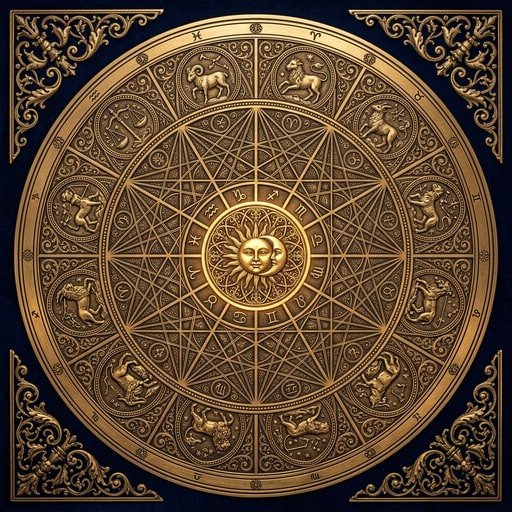
Sacred Ecliptic Geometry & Ptolemaic Aspects
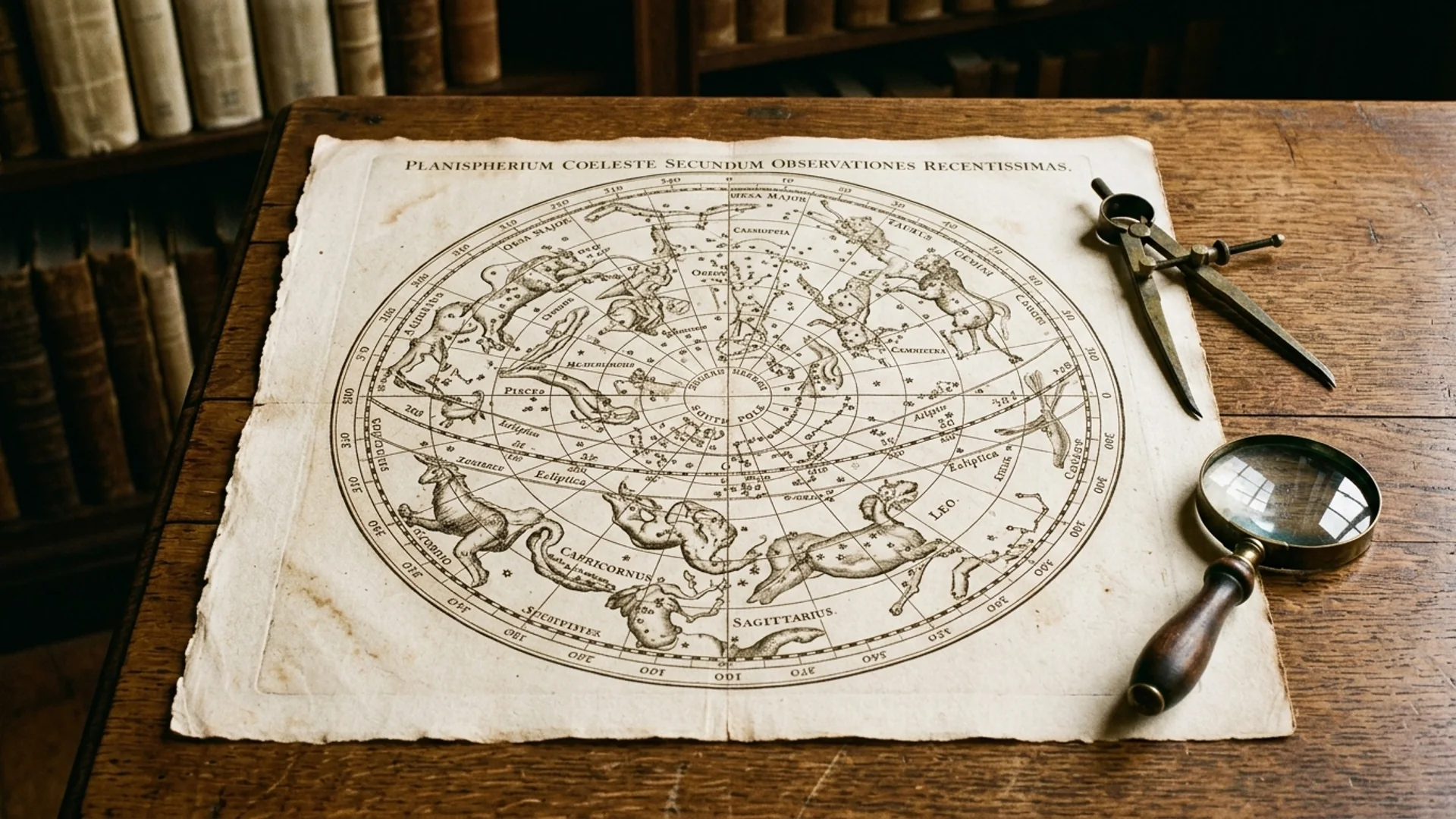
The 360° celestial circle partitioned into 4 elemental triplicities, 3 energetic modalities, and harmonic angular chords. • Modeled after Andreas Cellarius' Harmonia Macrocosmica (1660 CE, Planisphaerium Stellatum)
Every zodiac sign in Western astrology is not an arbitrary list of character traits. Rather, each of the twelve signs is the precise mathematical intersection of One Element (Triplicity) and One Dynamic Modality (Quadruplicity).
This elegant $4 \times 3$ structural matrix provides the foundational taxonomy of psychological temperament, energetic orientation, and elemental balance in natal chart analysis.
+-----------------------------------------------------------------------------+
|                      THE 4×3 ELEMENT & MODALITY MATRIX                      |
|                                                                             |
|  ELEMENT / MODALITY     CARDINAL (Initiating)  FIXED (Sustaining)  MUTABLE (Adapting)
|  ────────────────────────────────────────────────────────────────────────── |
|  FIRE  (Hot & Dry)      ♈ ARIES               ♌ LEO              ♐ SAGITTARIUS  |
|  EARTH (Cold & Dry)     ♑ CAPRICORN           ♉ TAURUS           ♍ VIRGO        |
|  AIR   (Hot & Moist)    ♎ LIBRA               ♒ AQUARIUS         ♊ GEMINI       |
|  WATER (Cold & Moist)   ♋ CANCER              ♏ SCORPIO          ♓ PISCES       |
+-----------------------------------------------------------------------------+
1. The Four Classical Elements (Triplicities)
Rooted in pre-Socratic Empedoclean natural philosophy and codified by Aristotle and Claudius Ptolemy, the four elements describe the fundamental energetic substance of psychological reality. In Jungian psychology, they correlate directly with the Four Psychological Functions of Consciousness:
+--------------------------------------------------------------------+
|               ELEMENTAL QUALITIES & JUNGIAN FUNCTIONS              |
|                                                                    |
|  FIRE  (Hot & Dry)   ──> INTUITION (Inspiration, Will, Vision)     |
|  EARTH (Cold & Dry)  ──> SENSATION (Material Reality, Structure)   |
|  AIR   (Hot & Moist) ──> THINKING  (Logic, Intellect, Connection)  |
|  WATER (Cold & Moist)──> FEELING   (Emotion, Empathy, Depth)       |
+--------------------------------------------------------------------+
1. Fire (Aries, Leo, Sagittarius)
- Aristotelian Quality: Hot and Dry (Active, Radiant, Ascending).
- Psychological Essence: Vitality, creative will, courage, enthusiasm, spontaneous self-expression, and future vision.
- Excess vs Deficiency: Excess leads to burnout, impatience, and impulsivity; deficiency manifests as low vitality and hesitation.
2. Earth (Taurus, Virgo, Capricorn)
- Aristotelian Quality: Cold and Dry (Grounding, Concrete, Form-Giving).
- Psychological Essence: Pragmatism, patience, sensory awareness, physical manifestation, endurance, and material security.
- Excess vs Deficiency: Excess produces rigidity, materialism, and fear of change; deficiency manifests as ungroundedness and difficulty executing practical tasks.
3. Air (Gemini, Libra, Aquarius)
- Aristotelian Quality: Hot and Moist (Diffuse, Circulating, Connecting).
- Psychological Essence: Intellectual curiosity, conceptual clarity, objectivity, social communication, and abstract synthesis.
- Excess vs Deficiency: Excess produces emotional detachment and intellectual paralysis; deficiency manifests as difficulty seeing the big picture or articulating concepts.
4. Water (Cancer, Scorpio, Pisces)
- Aristotelian Quality: Cold and Moist (Receptive, Binding, Dissolving).
- Psychological Essence: Emotional depth, instinctual empathy, psychic sensitivity, artistic imagination, and soul connection.
- Excess vs Deficiency: Excess creates emotional overwhelm and boundary dissolution; deficiency manifests as difficulty accessing or honoring vulnerable feelings.
2. The Three Modalities (Quadruplicities)
While elements describe what energy is operating, modalities describe how that energy moves through time and structures experience:
                  ┌─────────────────────────────────────────┐
                  │            THE MODALITY CYCLE           │
                  │                                         │
                  │   [ CARDINAL ] ──> [ FIXED ] ──> [ MUTABLE ]
                  │   (Initiates)      (Stabilizes)  (Transforms)
                  └─────────────────────────────────────────┘
1. Cardinal (Aries, Cancer, Libra, Capricorn)
- Astronomical Marker: Begins at the Solstices and Equinoxes (the four seasonal turning points).
- Dynamic Mode: Initiating, pioneering, launching, directing, and generating momentum.
2. Fixed (Taurus, Leo, Scorpio, Aquarius)
- Astronomical Marker: Occupies the middle of each season when the climate is most stable and concentrated.
- Dynamic Mode: Consolidating, preserving, enduring, deepening, and providing structural loyalty.
3. Mutable (Gemini, Virgo, Sagittarius, Pisces)
- Astronomical Marker: Occupies the end of each season as the weather transitions into the next epoch.
- Dynamic Mode: Adapting, synthesizing, editing, learning, and preparing for cyclical renewal.
3. Calculating Your Personal Elemental & Modality Balance
In a complete natal chart, your Sun sign represents only one placement among ten planetary bodies and angles (Ascendant, Midheaven). Astrologers evaluate your Elemental Scorecard by tallying the planetary weights across all four elements:
$$\text{Elemental Weight} = \sum (\text{Planet}_{\text{Sun, Moon, ASC}} \times 2) + \sum (\text{Inner Planets} \times 1) + \sum (\text{Outer Planets} \times 0.5)$$
Calculate your exact elemental and modality distribution in our free, privacy-first Birth Chart Calculator and explore cross-sign relationship synergy in our Compatibility Center.
Historical Sources & Epistemological Citations
OmniZodiac strictly documents astronomical, calendrical, and historical sources. Calculations follow deterministic formulas (VSOP87, GMT 584283, Chinese lunisolar ephemeris) while interpretive models remain tools for personal reflection.
- Arroyo, Stephen. Astrology, Psychology, and the Four Elements. CRCS Publications, 1975.
- Ptolemy, Claudius. Tetrabiblos (Book I). Harvard University Press, 1940.
- Greene, Liz & Howard Sasportas. The Development of the Personality. Samuel Weiser, 1987.
- Jung, Carl Gustav. Psychological Types (Collected Works Vol. 6). Princeton University Press, 1971.
- Hand, Robert. Horoscope Symbols. Whitford Press, 1981.