What is the mathematical and historical difference between Whole Sign and Placidus quadrant house division?
Whole Sign uses zodiacal signs as houses based on Hellenistic origins, while Placidus calculates dynamic time-proportional division of the celestial sphere.
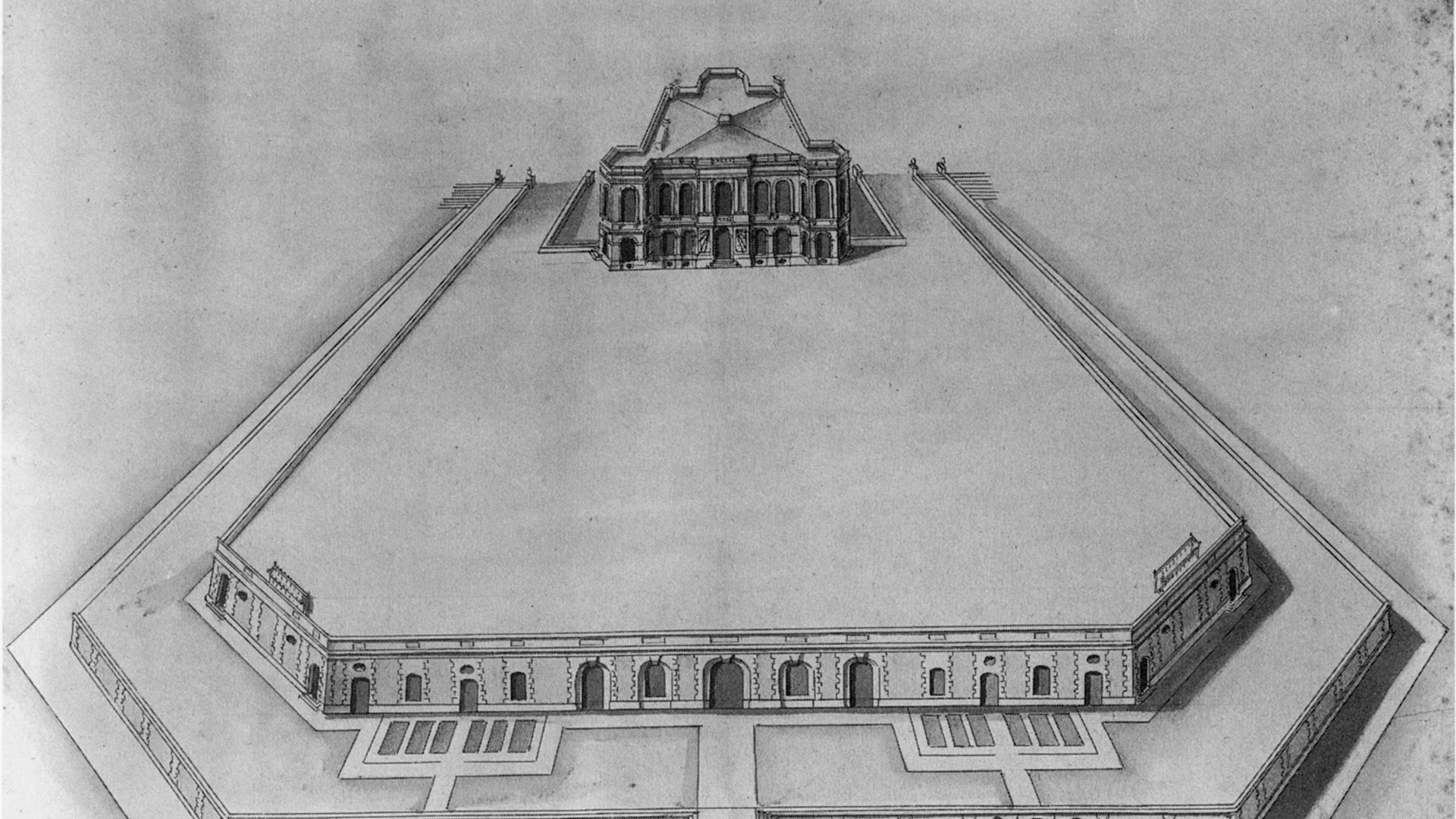
Historical copperplate engraving of the Paris Observatory (*Observatoire de Paris*, founded 1667), designed by Claude Perrault and directed by Jean-Dominique Cassini, birthplace of precision ephemeris tables and Ole Rømer's speed-of-light discovery.
Celestial Sphere Projection & House Cusps
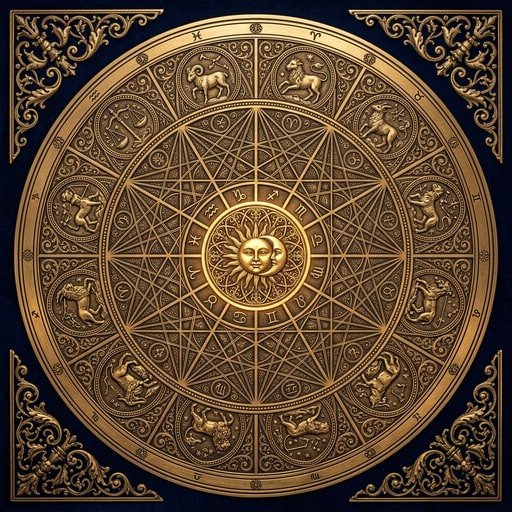
Comparing Hellenistic Whole Sign equal sectors with Placidus quadrant temporal space division across Horizon and Meridian axes. • Modeled after 16th-century European brass astrolabe horizon plates (Arsenius / Cole tradition)
(LAT / LONG) — Local Geocentric Topocentric Origin
In natal astrology, planetary positions calculated along the 360° ecliptic are projected into twelve houses (topoi), representing distinct experiential arenas of human life (such as self, resources, ancestry, vocation, and partnerships).
However, no single consensus exists on how to divide the celestial sphere into these twelve segments. Over the past two millennia, astronomers and astrologers have developed more than twenty distinct mathematical formulas—known as House Systems.
+-----------------------------------------------------------------------------+
|                     HOUSE SYSTEMS MATHEMATICAL TAXONOMY                     |
|                                                                             |
|  1. ECLIPTIC SIGN-BASED (Whole Sign)                                        |
|     • 1 Zodiac Sign = 1 House (Exact 30° equal sectors)                     |
|     • Ascendant sets Sign 1; MC floats freely as an independent angle point |
|                                                                             |
|  2. EQUAL SPACE DIVISION (Equal House)                                      |
|     • 12 equal 30° arcs measured along the ecliptic from exact ASC degree   |
|                                                                             |
|  3. QUADRANT TIME DIVISION (Placidus, Koch)                                 |
|     • Trisects semi-diurnal and semi-nocturnal planetary transit time arcs  |
|     • Generates unequal house cusp sizes based on latitude and obliquity    |
|                                                                             |
|  4. PRIME VERTICAL SPACE DIVISION (Campanus, Regiomontanus)                 |
|     • Trisects the Prime Vertical / Equator great circles                   |
+-----------------------------------------------------------------------------+
1. The Fundamental Geometry of the Celestial Sphere
Every horoscopic chart is anchored by two fundamental astronomical axes intersecting at the observer’s geographic location (latitude $\phi$ and longitude $\lambda$):
- The Horizon Axis (Ascendant – Descendant): The great circle of the horizon where the sky meets the Earth. The eastern intersection with the ecliptic is the Ascendant (ASC); the western intersection is the Descendant (DSC).
- The Meridian Axis (Midheaven / MC – Imum Coeli / IC): The great circle passing through the celestial poles and the observer’s zenith. The upper intersection with the ecliptic is the Medium Coeli (MC / Midheaven); the lower northern intersection is the Imum Coeli (IC / Nadir).
                    Upper Meridian (Zenith)
                               ▲
                               │
                       10      │      9
                  11           │           8
             12                │                7
       ───────[ASC]────────────┼────────────[DSC]─────── Horizon
              (East)           │           (West)
              1                │                6
                   2           │           5
                        3      │      4
                               │
                               ▼
                    Lower Meridian (Nadir)
2. Whole Sign Houses: The Classical Hellenistic System
The Whole Sign System is the oldest documented house system in Western horoscopy, utilized ubiquitously throughout the Greco-Roman world by authors including Dorotheus of Sidon, Vettius Valens, and Claudius Ptolemy.
Mathematical Definition
In Whole Sign Houses, the entire 30° zodiac sign that contains the Ascendant degree becomes the First House. The subsequent zodiac sign becomes the Second House, continuing in natural zodiacal order for all twelve houses.
$$\text{House 1} = 0^\circ\text{ to }30^\circ\text{ of the Ascendant’s Sign}$$ $$\text{House 2} = 0^\circ\text{ to }30^\circ\text{ of the Next Zodiac Sign}$$
Key Architectural Characteristics
- Sign-House Equivalence: There is no ambiguous overlap where a single house contains portions of two or three zodiac signs.
- The Floating Midheaven (MC): Unlike quadrant systems where the MC is mathematically forced to serve as the 10th house cusp, in Whole Sign the MC remains an independent floating angle point that can fall in the 9th, 10th, 11th, or even 8th or 12th house depending on terrestrial latitude.
- Global Stability: Because Whole Sign relies purely on sign boundaries along the ecliptic, it operates flawlessly at all latitudes on Earth, including within the Arctic and Antarctic circles ($>66.5^\circ$).
3. Placidus: Quadrant Time Division
The Placidus House System was formulated by 17th-century Italian Olivetan monk, mathematician, and professor Placidus de Titis (1603–1668) in his treatise Physiomathematica (1650) and popularized by Raphael’s printed ephemerides in 19th-century England.
Mathematical Formulation
Placidus is a semi-diurnal time-proportionate system. Rather than dividing geometric space, Placidus divides the time required for a point on the celestial sphere to travel from the eastern horizon (ASC) to the upper meridian (MC):
- The diurnal arc (from ASC to MC) is trisected into three equal time intervals of oblique ascension, generating the cusps for the 12th and 11th houses.
- The nocturnal arc (from IC to ASC) is trisected into three equal time intervals of oblique ascension, generating the cusps for the 2nd and 3rd houses.
+--------------------------------------------------------------------+
|               PLACIDUS TIME-TRISECTION MECHANICS                   |
|                                                                    |
|  Horizon (ASC) ───[ 1/3 Diurnal Time ]───> 12th House Cusp         |
|  12th Cusp     ───[ 1/3 Diurnal Time ]───> 11th House Cusp         |
|  11th Cusp     ───[ 1/3 Diurnal Time ]───> Midheaven (MC / 10th)   |
+--------------------------------------------------------------------+
Intercepted Signs in Placidus
Because the angle between the ecliptic and the local horizon varies dramatically depending on latitude and season, Placidus houses are unequal in size (ranging from $<15^\circ$ to $>60^\circ$ at mid-latitudes). When a house spans more than 30°, an entire zodiac sign may be swallowed inside the house without touching a cusp—known as an intercepted sign.
4. The Polar Latitude Breakdown
At terrestrial latitudes north of the Arctic Circle ($+66.5^\circ$) or south of the Antarctic Circle ($-66.5^\circ$), the ecliptic never rises or sets during certain periods of the year (Midnight Sun / Polar Night).
- In Quadrant Systems (Placidus, Koch, Regiomontanus): The mathematical equations divide by zero or encounter negative trigonometric roots ($|\tan \phi \tan \epsilon| > 1$). The Ascendant and Midheaven can coincide or rotate backwards, causing quadrant algorithms to completely crash.
- In Whole Sign & Equal House Systems: The system remains mathematically sound because houses are determined by the ecliptic coordinates itself, ensuring consistent readings worldwide.
5. Comparative Evaluation: When to Use Each System
| Dimension | Whole Sign System | Placidus Quadrant System | Equal House System |
|---|---|---|---|
| Historical Provenance | Hellenistic (c. 150 BCE – 600 CE) | Renaissance (1650 CE) | Classical & Medieval |
| Mathematical Basis | 30° Sign Boundaries | Semi-diurnal Time Trisection | 30° Ecliptic Arcs from ASC |
| Angles (ASC / MC) | ASC sets 1st House; MC floats | ASC = 1st Cusp; MC = 10th Cusp | ASC = 1st Cusp; MC floats |
| Polar Latitude Safety | 100% Mathematically Stable | Fails above $66.5^\circ$ Latitude | 100% Mathematically Stable |
| Intercepted Signs | None (0% Interceptions) | Frequent at mid/high latitudes | None (0% Interceptions) |
| Primary Analytical Focus | Holistic Archetypal Life Domains | Time-Sensitive Event Manifestation | Individual Horizon Geometry |
At OmniZodiac, users can switch between Whole Sign and Placidus with a single click in our Birth Chart Calculator, comparing both perspectives with 100% deterministic accuracy.
Historical Sources & Epistemological Citations
OmniZodiac strictly documents astronomical, calendrical, and historical sources. Calculations follow deterministic formulas (VSOP87, GMT 584283, Chinese lunisolar ephemeris) while interpretive models remain tools for personal reflection.
- Holden, Ralph William. The Elements of House Division. L.N. Fowler & Co., 1977.
- Brennan, Chris. Hellenistic Astrology: The Study of Fate and Fortune. Amor Fati Publications, 2017.
- Placidus de Titis. Primum Mobile (trans. John Cooper). Davis and Dickson, 1814.
- Meeus, Jean. Astronomical Algorithms (2nd Edition). Willmann-Bell, 1998.
- Kassell, Lauren. Medicine and Magic in Elizabethan London: Simon Forman. Oxford University Press, 2005.