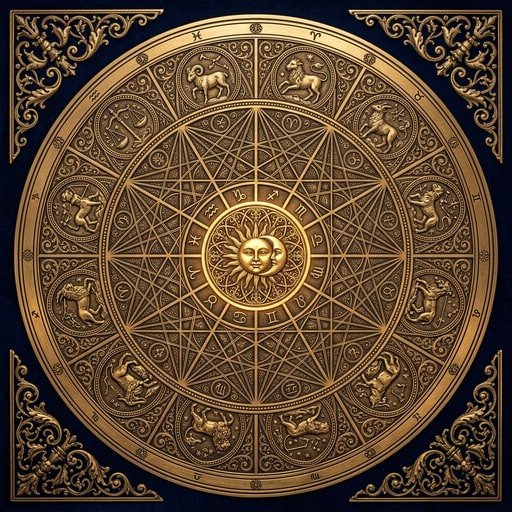
How do the 8 distinct lunar illumination phases from New to Full Moon shape psychological cycles and intentional timing?
The 29.53-day synodic cycle provides an organic rhythm: waxing phases favor building and action, while waning phases favor harvest, discernment, and release.
The 29.53-Day Synodic Lunar Cycle
The 8 astronomical phases of the Moon governed by Sun-Earth-Moon orbital angular geometry and illumination percentage. • Modeled after Galileo Galilei's Sidereus Nuncius (1610 CE) & NASA LRO Global Lunar Morphology Mosaic
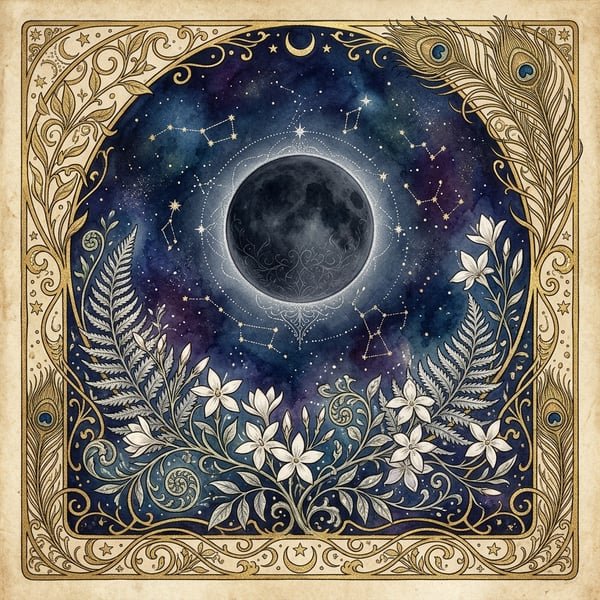
New Moon
Day 0 / 29.5Conjunction with the Sun. Stillness and inner reflection.
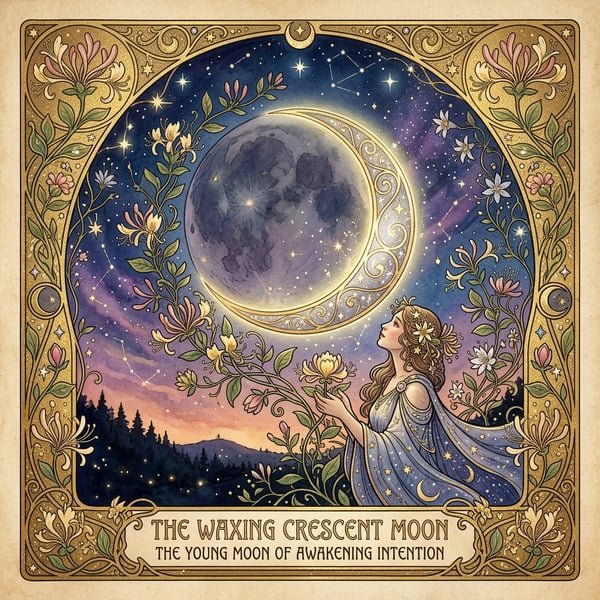
Waxing Crescent
Days 1–6First sliver of light. Momentum builds through discernment.
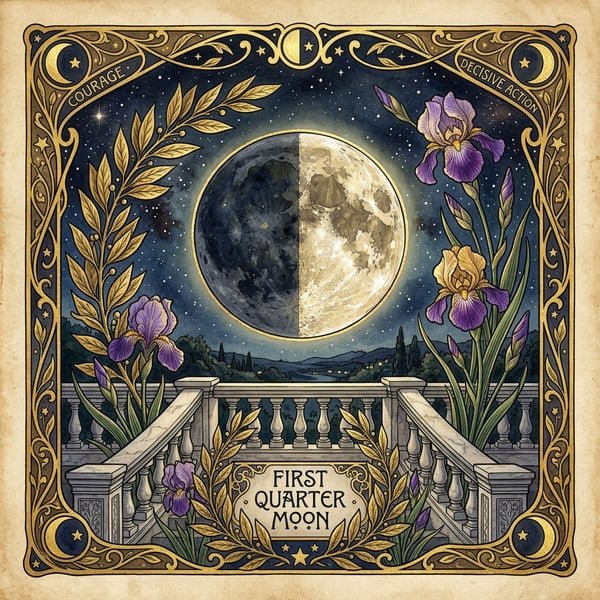
First Quarter
Days 7–9Exact 90° quadrature. Overcoming friction through decisive action.
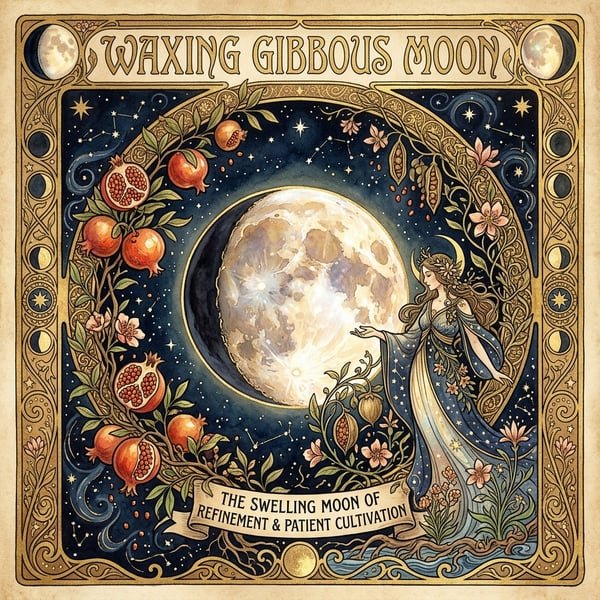
Waxing Gibbous
Days 10–13Approaching culmination. Refining focus and cultivating patience.
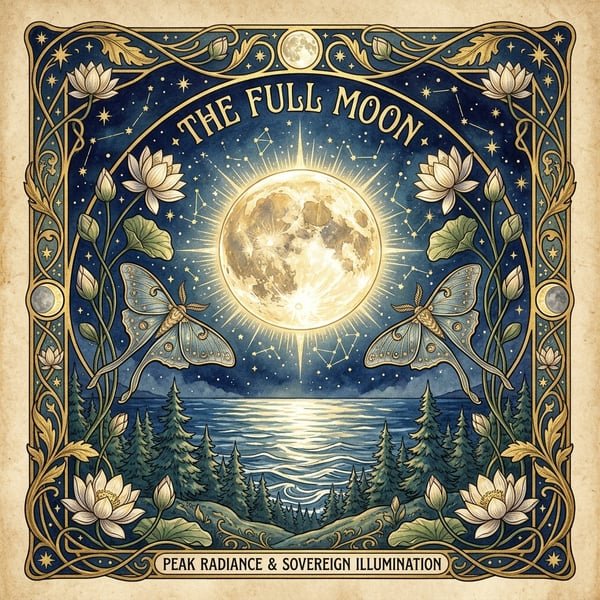
Full Moon
Days 14–16Maximum solar reflection. Culmination, clarity, and harvest.
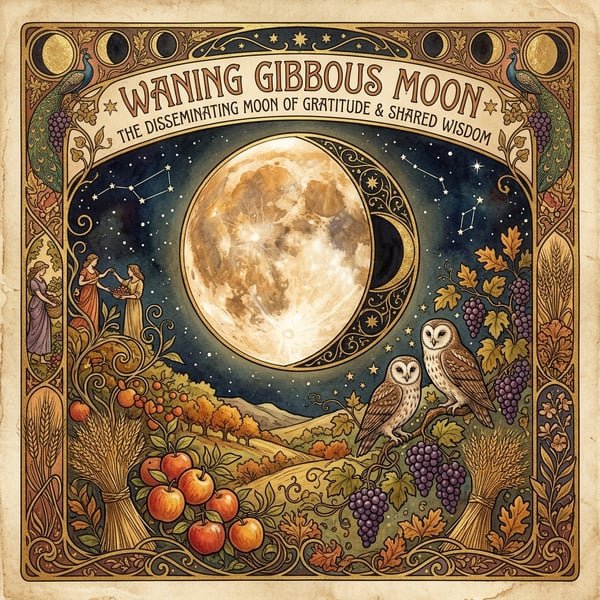
Waning Gibbous
Days 17–21Disseminating wisdom. Sharing insights and expressing gratitude.
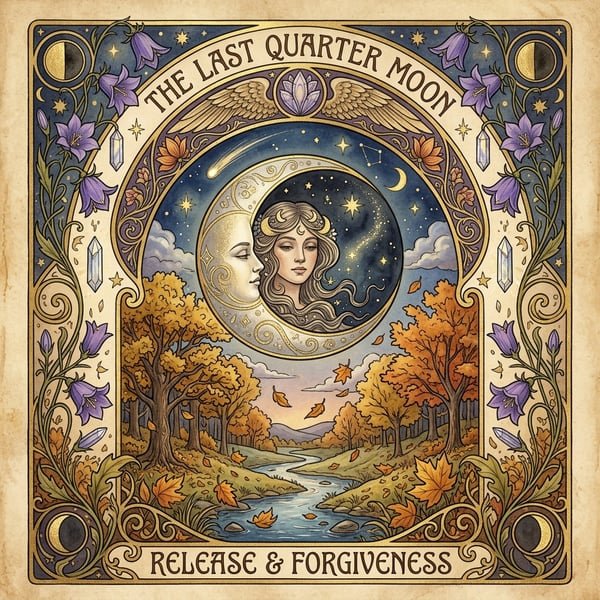
Last Quarter
Days 22–24Descending quadrature. Releasing obsolete attachments.
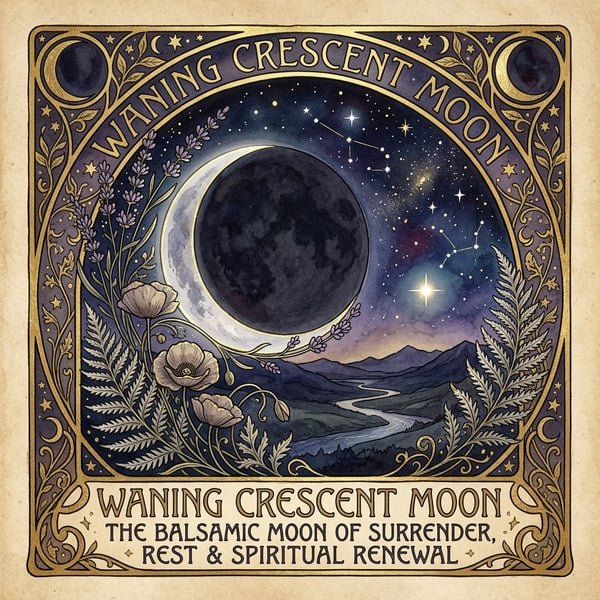
Waning Crescent
Days 25–28Balsamic silver arc. Restorative surrender before renewal.
The Moon is the fastest-moving celestial body in our sky, completing a full orbit around Earth relative to the background stars in 27.32 days (the sidereal month) and completing a full cycle of illuminated phases relative to the Sun in 29.53 days (the synodic month).
In psychological and archetypal astrology, the 29.53-day Lunation Cycle provides a natural, organic clock governing rhythms of intention, action, peak expression, and reflective release.
+-----------------------------------------------------------------------------+
|                     THE 8 SYNODIC MOON PHASES MATRIX                        |
|                                                                             |
|  Phase 1: NEW MOON        (  0°– 44.9° Elongation) • 0% Illumination        |
|  Phase 2: WAXING CRESCENT ( 45°– 89.9° Elongation) • 1%–49% Illumination    |
|  Phase 3: FIRST QUARTER   ( 90°–134.9° Elongation) • 50% Illumination       |
|  Phase 4: WAXING GIBBOUS  (135°–179.9° Elongation) • 51%–99% Illumination   |
|  Phase 5: FULL MOON       (180°–224.9° Elongation) • 100% Illumination      |
|  Phase 6: WANING GIBBOUS  (225°–269.9° Elongation) • 99%–51% Illumination   |
|  Phase 7: LAST QUARTER    (270°–314.9° Elongation) • 50% Illumination       |
|  Phase 8: WANING CRESCENT (315°–359.9° Elongation) • 49%–1% Illumination    |
+-----------------------------------------------------------------------------+
1. Astronomical Mechanics of Lunar Phases
Lunar phases are not caused by the shadow of the Earth falling on the Moon (which is an eclipse). Rather, they are purely a consequence of angular elongation ($\Delta \lambda$)—the difference in celestial longitude between the Sun and Moon as viewed from Earth:
$$\Delta \lambda = (\lambda_{\text{Moon}} - \lambda_{\text{Sun}}) \pmod{360^\circ}$$
As the Moon orbits counter-clockwise around the Earth, the proportion of its sunlit hemisphere visible to an observer on Earth shifts smoothly from 0% (conjunction / New Moon) to 100% (opposition / Full Moon) and back to 0%.
2. Detailed Breakdown of the 8 Lunar Phases
                  ┌─────────────────────────────────────────┐
                  │        WAXING (BUILDING LIGHT)          │
                  │   New Moon ──> Crescent ──> 1st Quarter │
                  │            ──> Waxing Gibbous           │
                  └────────────────────┬────────────────────┘
                                       │
                                [ FULL MOON ] (Peak Light)
                                       │
                  ┌────────────────────▼────────────────────┐
                  │       WANING (RELEASING LIGHT)          │
                  │   Waning Gibbous ──> Last Quarter       │
                  │            ──> Balsamic (Dark Moon)     │
                  └─────────────────────────────────────────┘
1. New Moon (0°–44.9° Solar-Lunar Arc)
- Astronomical State: Conjunction (Moon rises and sets with the Sun). The night sky is completely dark.
- Psychological Theme: Initiation, instinctual beginnings, clean slates, and the planting of subconscious seeds.
- Archetype: The Pioneer / The Sower.
2. Waxing Crescent (45°–89.9° Solar-Lunar Arc)
- Astronomical State: Semi-Sextile to Octile. A thin sliver of light emerges in the western sky just after sunset.
- Psychological Theme: Overcoming initial friction, emerging momentum, committing resources to the seed.
- Archetype: The Explorer / The Sprout.
3. First Quarter (90°–134.9° Solar-Lunar Arc)
- Astronomical State: Square Aspect (Half-illuminated). The Moon rises at solar noon and sets at midnight.
- Psychological Theme: “Crisis in action.” Decisive restructuring, resolving inner tension, breaking through inertia.
- Archetype: The Builder / The Decision-Maker.
4. Waxing Gibbous (135°–179.9° Solar-Lunar Arc)
- Astronomical State: Trine to Sesquiquadrate. Over 75% illuminated, growing bulbous in the evening sky.
- Psychological Theme: Refinement, dedication, continuous improvement, and eager anticipation of culmination.
- Archetype: The Craftsman / The Scholar.
5. Full Moon (180°–224.9° Solar-Lunar Arc)
- Astronomical State: Opposition (100% Illuminated). The Moon rises exactly as the Sun sets and illuminates the entire night.
- Psychological Theme: Total illumination, emotional culmination, conscious objectivity, and relational awareness.
- Archetype: The Visionary / The Revelator.
6. Waning Gibbous / Disseminating (225°–269.9° Solar-Lunar Arc)
- Astronomical State: Trine to Inconjunct. Light begins to diminish.
- Psychological Theme: Sharing harvest insights, teaching, distributing knowledge, and communal gratitude.
- Archetype: The Teacher / The Philanthropist.
7. Last / Third Quarter (270°–314.9° Solar-Lunar Arc)
- Astronomical State: Waning Square (Half-illuminated). The Moon rises at midnight and remains visible in morning daylight.
- Psychological Theme: “Crisis in consciousness.” Re-evaluating beliefs, discarding outdated structures, forgiveness.
- Archetype: The Reformer / The Philosopher.
8. Waning Crescent / Balsamic (315°–359.9° Solar-Lunar Arc)
- Astronomical State: Dark Moon approach. A fragile crescent visible in the eastern sky just before dawn.
- Psychological Theme: Surrender, deep restorative rest, dreamwork, release of karma, and psychic clearing.
- Archetype: The Mystic / The Sage.
3. The Natal Lunar Phase
Pioneered by humanistic astrologer Dane Rudhyar in The Lunation Cycle (1967), your Natal Moon Phase is determined by the angular distance between the Sun and Moon at your exact moment of birth.
While your Sun sign describes your conscious core identity and your Moon sign describes your emotional processing mode, your Natal Phase describes your overarching temperamental stance toward time and life development:
- Waxing Types (Phases 1–4): Spontaneous, projective, forward-moving, building outward structures in society.
- Full Moon Types (Phase 5): Highly conscious, sensitive to relationship polarities, synthesizing opposing perspectives.
- Waning Types (Phases 6–8): Reflective, meaning-oriented, teaching, synthesizing collective culture and wisdom.
You can calculate your exact Natal Moon Phase and degree in our free, privacy-first Birth Chart Calculator and track current daily lunations on our live Moon Calendar.
Historical Sources & Epistemological Citations
OmniZodiac strictly documents astronomical, calendrical, and historical sources. Calculations follow deterministic formulas (VSOP87, GMT 584283, Chinese lunisolar ephemeris) while interpretive models remain tools for personal reflection.
- Rudhyar, Dane. The Lunation Cycle: A Key to the Understanding of Personality. Shambhala Publications, 1967.
- Meeus, Jean. Astronomical Algorithms (2nd Edition). Willmann-Bell, 1998.
- Buzsáki, György. Rhythms of the Brain. Oxford University Press, 2006.
- Aveni, Anthony F. Empires of Time: Calendars, Clocks, and Cultures. Tauris Parke Paperbacks, 2002.
- Ptolemy, Claudius. Tetrabiblos (trans. F.E. Robbins). Harvard University Press, 1940.