

Scope, Epistemological Stratification & Privacy
OmniZodiac delivers deterministic astronomical computation paired with transparent epigraphic documentation. To maintain absolute academic and scientific integrity, our Chinese Zodiac engine enforces a rigorous four-tier epistemological stratification, separating verified celestial mechanics, archaeological primary evidence, classical imperial astrometry, and modern interpretive synthesis.
VSOP87 Solar Terms & Lunisolar Ephemeris
Deterministic geocentric solar longitude (λ = 315° for Lichun) and synodic new moons computed locally via analytical series expansions. Ephemeral, private, zero telemetry.
Shang Oracle Bones & Warring States Relics
Epigraphic Ganzhi tables carved on ox scapulae at Yinxu (c. 1200 BCE) and the 28 Lunar Mansions lacquer chest of Marquis Yi of Zeng (433 BCE).
Han Shichen & Tang-Song Planispheres
Diurnal double-hour (Shichen) azimuth coordinates, Wang Chong’s Lunheng zoomorphic correspondences, Dunhuang manuscript star atlas (c. 700 CE), and Guo Shoujing's Shoushi Calendar.
Archetypal Introspection & Comparative Fusion
Traditional character traits and cross-tradition fusion frameworks badged transparently for personal reflection; strictly devoid of fatalistic claims or sensationalized fortune-telling.
Client-Side Privacy Guarantee
astronomy-engine. Zero birth dates, timestamps, or personal data are ever transmitted to external servers or logged in databases.
The 3,200-Year Historical Architecture: From Yinxu to the Ming Armillary
The Chinese sexagenary cycle (Ganzhi) is among humanity's oldest attested calendar systems, with documented epigraphic records spanning over three millennia. Conflating pop-culture animal horoscopes with ancient astronomical horology obscures this monumental achievement. OmniZodiac stratifies the tradition across five distinct archaeological epochs:
Epigraphic Ganzhi Tables & Sacrificial Divination
Excavations at Yinxu Pit YH127 yielded complete sexagenary tables meticulously incised on bovine scapulae and turtle plastrons. Used by court diviners under King Wu Ding to track ancestral sacrifice cycles and solar day intervals, this epigraphic evidence confirms that the 60-element cyclic sequence operated identically to modern computation over 3,200 years ago.
Marquis Yi of Zeng 28 Lunar Mansions Lacquer Chest
Excavated from Tomb No. 1 at Leigudun, this ceremonial lacquer chest bears the earliest surviving complete physical inscription of the 28 Lunar Mansions (Ershiba Xiu). The mansions encircle the central character Dou (Big Dipper), flanked by the Azure Dragon and White Tiger, proving that the equatorial sidereal coordinate system was fully codified by the 5th century BCE.
The Dunhuang Star Atlas (British Library Or.8210/S.3326)
The world’s earliest surviving complete manuscript celestial map, executed on fine mulberry paper. Discovered in Cave 17 of the Mogao complex, it depicts 1,339 stars organized into 257 asterisms, standardizing the division of the celestial sphere into the Three Enclosures (San Yuan) and Twenty-Eight Lunar Mansions with unprecedented astrometric fidelity.
Su Song Water-Powered Clock Tower & Suzhou Planisphere Stele
Su Song’s 12-meter clock tower (Shuiyun Yixiangtai) coupled an astronomical escapement waterwheel to an equatorial armillary sphere, mechanically synchronizing Shichen double-hours with stellar transits. In 1247 CE, Wang Zhiyuan engraved the monumental Suzhou Planisphere Stele, immortalizing Song imperial coordinate astronomy in indestructible stone.
Guo Shoujing's Gaocheng Gnomon & The Beijing Armillary Sphere
Guo Shoujing’s 40-foot brick gnomon at Gaocheng measured solar meridian transit shadow lengths to determine the tropical year length as 365.2425 days (Shoushi Calendar, 1281 CE)—matching the modern Gregorian value 300 years ahead of Europe. In 1442 CE, the Ming court cast the monumental bronze armillary sphere now atop the Beijing Ancient Observatory, establishing the definitive spatial coordinate reference.
Mathematical Model & Ephemeris Computation
Determining a user’s Chinese Zodiac animal, Heavenly Stem, Earthly Branch, and Wuxing phase requires precise celestial mechanics and modular arithmetic. OmniZodiac implements the rigorous algorithms defined below:
1. Astrological vs. Civil New Year Boundary
In traditional Chinese metaphysics and Four Pillars of Destiny (Bazi), the astrological year does not change on January 1st, nor on the civil Lunar New Year (Chunjie). Instead, it shifts at the exact astronomical instant of Lìchūn (立春, "Start of Spring"), defined as the moment apparent tropical solar longitude reaches exactly 315°:
Lìchūn: λ&sun; = 315.0000° (approx. February 3–5 UTC) For civil lunar calendar queries, the New Year occurs at the second astronomical New Moon (conjunction where λ&moon; = λ&sun;) following the Winter Solstice (λ&sun; = 270°). OmniZodiac’s calculator evaluates both boundaries, providing complete astronomical transparency.
2. Sexagenary Ganzhi Cycle Invariant: LCM(10, 12) = 60
The Sexagenary cycle pairs 10 Heavenly Stems (Tiāngān) with 12 Earthly Branches (Dìzhī). Because both numbers share an even divisor (gcd(10, 12) = 2), odd stems (Yang) only ever pair with odd branches (Yang), and even stems (Yin) with even branches (Yin). The total number of valid pairs is:
Total Unique Pairs = LCM(10, 12) = (10 × 12) / GCD(10, 12) = 120 / 2 = 60 Given an astronomical solar year Y (where the year begins at Lichun), the cycle index K ∈ {0, 1, ..., 59} relative to the anchor year 1984 (Order 1: Jiǎ-Zǐ / Wood Rat) is calculated as:
K = (Y - 4) mod 60 Stem Index: S = K mod 10 (0 = 甲 Jiǎ, 1 = 乙 Yǐ, ..., 9 = 癸 Guǐ) Branch Index: B = K mod 12 (0 = 子 Zǐ / Rat, 1 = 丑 Chǒu / Ox, ..., 11 = 亥 Hài / Pig) 3. Shichen Double-Hour Diurnal Division
The 24-hour civil day is divided into twelve equal 2-hour segments called Shíchen (时辰), centered on true local solar time. Midnight belongs to the first branch, Zǐ (子):
| Branch | Animal | Solar Time Range | Azimuth Angle | Fixed Element | Polarity |
|---|---|---|---|---|---|
| 子 Zǐ | Rat (鼠) | 23:00 – 01:00 | 0° (Due North) | Water | Yang |
| 丑 Chǒu | Ox (牛) | 01:00 – 03:00 | 30° (North-Northeast) | Earth | Yin |
| 寅 Yín | Tiger (虎) | 03:00 – 05:00 | 60° (East-Northeast) | Wood | Yang |
| 卯 Mǎo | Rabbit (兔) | 05:00 – 07:00 | 90° (Due East) | Wood | Yin |
| 辰 Chén | Dragon (龙) | 07:00 – 09:00 | 120° (East-Southeast) | Earth | Yang |
| 巳 Sì | Snake (蛇) | 09:00 – 11:00 | 150° (South-Southeast) | Fire | Yin |
| 午 Wǔ | Horse (马) | 11:00 – 13:00 | 180° (Due South) | Fire | Yang |
| 未 Wèi | Goat (羊) | 13:00 – 15:00 | 210° (South-Southwest) | Earth | Yin |
| 申 Shēn | Monkey (猴) | 15:00 – 17:00 | 240° (West-Southwest) | Metal | Yang |
| 酉 Yǒu | Rooster (鸡) | 17:00 – 19:00 | 270° (Due West) | Metal | Yin |
| 戌 Xū | Dog (狗) | 19:00 – 21:00 | 300° (West-Northwest) | Earth | Yang |
| 亥 Hài | Pig (猪) | 21:00 – 23:00 | 330° (North-Northwest) | Water | Yin |
Primary Archaeoastronomical Evidence & Documentary Dossier
Examine high-resolution photographic documentation, museum locations, and historical significance for the seven primary physical monuments anchoring our ephemeris calculations:
Chinese Archaeoastronomy & Epigraphic Dossier
Seven primary excavated epigraphic monuments, monumental stone planispheres, and ancient imperial observatories chronicling 3,200 years of unbroken lunisolar timekeeping.

Yinxu Carved Ox Scapula Sexagenary Table (甲骨干支表)
- Historical Period & Dating
- Shang Dynasty (c. 1200 BCE, King Wu Ding Reign)
- Current Repository / Discovery Site
- National Museum of China, Beijing / Yinxu Archaeological Site
Archaeoastronomical Significance
Provides documented primary archaeological evidence that the 60-element Ganzhi sequence has been recorded since the late Shang dynasty.

Marquis Yi of Zeng 28 Lunar Mansions Lacquer Chest (曾侯乙漆箱)
- Historical Period & Dating
- Early Warring States Period (433 BCE)
- Current Repository / Discovery Site
- Hubei Provincial Museum, Wuhan, Hubei
Archaeoastronomical Significance
The world’s earliest physical archaeological inscription proving the Chinese 28 lunar mansions system was fully codified by the 5th century BCE.

Dunhuang Tang Dynasty Manuscript Star Atlas (敦煌星图)
- Historical Period & Dating
- Tang Dynasty (c. 700 CE)
- Current Repository / Discovery Site
- British Library, London (Stein Collection Or.8210/S.3326)
Archaeoastronomical Significance
Documents the ancient Chinese division of the sky into 3 Enclosures (San Yuan) and 28 Lunar Mansions (Ershiba Xiu).

Su Song Water-Powered Astronomical Clock Tower (水运仪象台)
- Historical Period & Dating
- Song Dynasty (1092 CE, Kaifeng)
- Current Repository / Discovery Site
- Documented in Xinyi Xiangfa (新仪象法要, National Library of China)
Archaeoastronomical Significance
Peak achievement of medieval mechanical timekeeping, synchronizing double-hours (Shichen) with celestial coordinate motion.
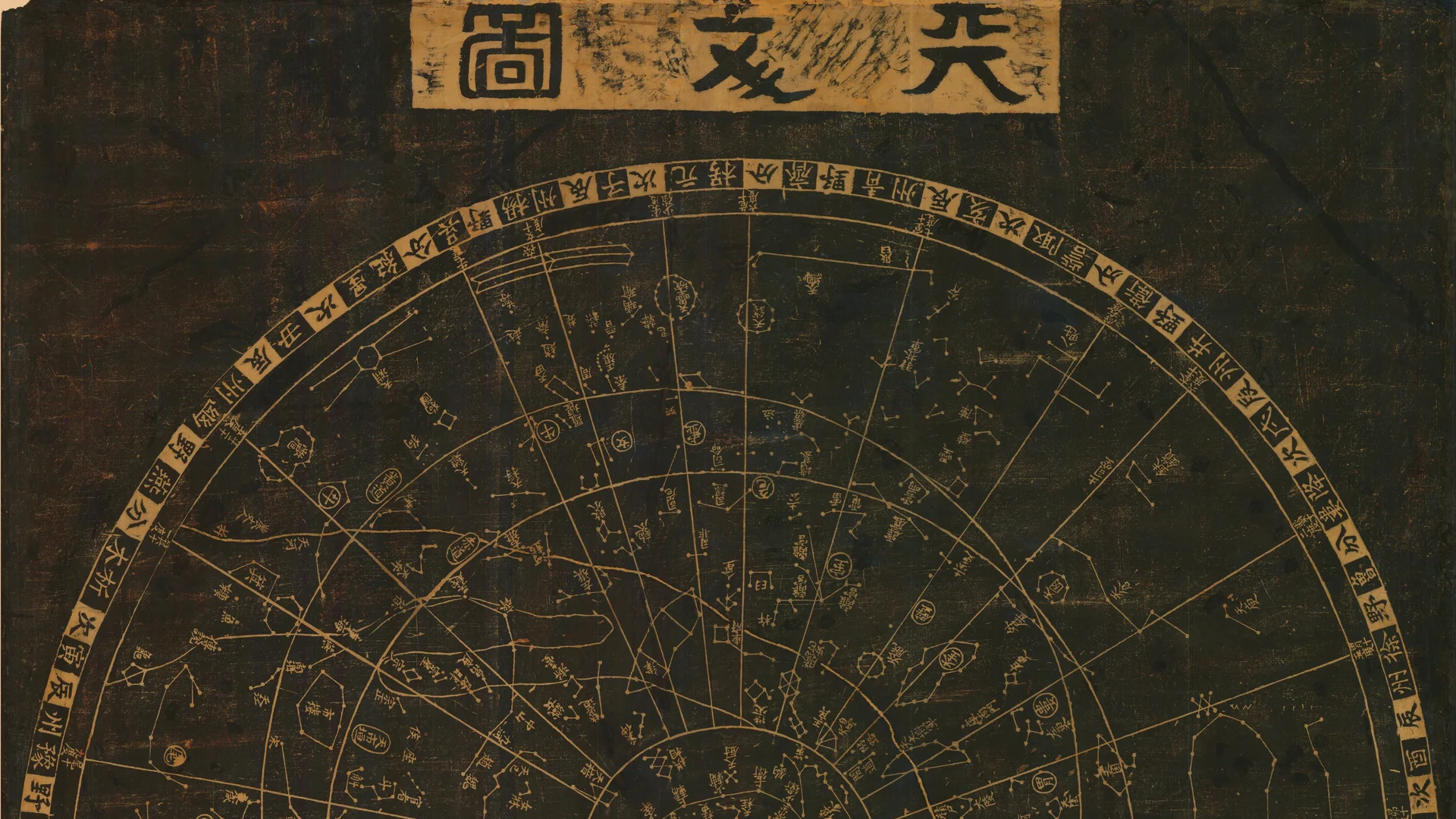
Suzhou Astronomical Planisphere Stele (苏州石刻天文图)
- Historical Period & Dating
- Southern Song Dynasty (1247 CE Engraved, 1193 CE Chart)
- Current Repository / Discovery Site
- Suzhou Inscription Museum, Jiangsu / UNESCO Memory of the World
Archaeoastronomical Significance
World-renowned astronomical artifact illustrating the exact coordinate geometry and equatorial projection used by Song imperial astronomers.

Gaocheng Astronomical Observatory & Great Gnomon (登封告成观星台)
- Historical Period & Dating
- Yuan Dynasty (1279 CE, Designed by Guo Shoujing)
- Current Repository / Discovery Site
- Dengfeng, Henan / UNESCO World Heritage Historic Monuments of Dengfeng
Archaeoastronomical Significance
Physical architectural monument of the Shoushi Calendar (1281 CE), matching the Gregorian calendar’s length 300 years before European adoption.

Beijing Ancient Observatory Bronze Armillary Sphere (浑天仪)
- Historical Period & Dating
- Ming Dynasty (1442 CE Cast)
- Current Repository / Discovery Site
- Beijing Ancient Observatory (北京古观象台), Jianguomen, Beijing
Archaeoastronomical Significance
Archetype for Chinese armillary instrument geometry that coordinated terrestrial azimuths with celestial declinations.
Peer-Reviewed Scholarly Bibliography
OmniZodiac’s calculations and epigraphic glosses derive from authoritative academic literature in sinology, archaeoastronomy, and the history of science:
Needham, Joseph, and Ling Wang (1959)
Science and Civilisation in China, Volume 3: Mathematics and the Sciences of the Heavens and the Earth. Cambridge: Cambridge University Press.Definitive Western treatment of Chinese astronomical instruments, coordinate systems, water clock escapements, and the 28 Lunar Mansions.
Sun, Xiaochun, and Jacob Kistemaker (1997)
The Chinese Sky During the Han: Constellating Stars and Society. Leiden: Brill.Comprehensive reconstruction of Han dynasty star catalogs, constellation boundaries, and the equatorial grid system.
Pankenier, David W. (2013)
Astrology and Cosmology in Early China: Conforming Earth to Heaven. Cambridge: Cambridge University Press.Meticulous archaeological investigation into planetary alignments, Shang oracle bone epigraphy, and the cosmic mandate in the 2nd millennium BCE.
Sivin, Nathan (2009)
Granting the Seasons: The Chinese Astronomical System of 1280, with a Study of Its Many Dimensions and a Working Translation of Its Treatises. New York: Springer.Complete translation and mathematical analysis of Guo Shoujing's Shoushi Calendar and the Gaocheng gnomon observatory measurements.
Shaughnessy, Edward L. (1991)
Sources of Western Zhou History: Inscribed Bronze Vessels. Berkeley: University of California Press.Standard reference for dating formulas, Ganzhi cyclical day records, and bronze inscription epigraphy.
Frequently Asked Questions & Edge Cases
Does my Chinese Zodiac sign change on January 1st, Lunar New Year, or Lìchūn?
OmniZodiac calculates your primary annual animal sign based on the Civil Lunar New Year (Chūn-jié), which aligns with cultural tradition and Purple Mountain Observatory standards. However, in Four Pillars of Destiny (Bazi) solar astrology, the annual branch transitions at the solar term Lìchūn (立春, approximately February 4th UTC, when the Sun reaches 315° ecliptic longitude). If you were born in late January or early February between Lunar New Year and Lichun, our calculator reports your civil Lunisolar animal sign while noting the Bazi solar boundary for full transparency.
Why are there only 60 combinations in the cycle instead of 120 (10 × 12)?
Because 10 Heavenly Stems and 12 Earthly Branches share an even parity factor (GCD = 2). A Yang Stem (odd) can only pair with a Yang Branch (odd), and a Yin Stem (even) can only pair with a Yin Branch (even). Mismatched pairings like Yang Wood + Yin Ox are mathematically forbidden in classical Ganzhi harmony, resulting in exactly LCM(10, 12) = 60 valid pairs.
What are the Four Celestial Symbols (Si Xiang)?
The ancient Chinese divided the nocturnal sky into four expansive quadrants, each governed by an archetypal celestial spirit animal: the Azure Dragon of the East (Spring, Wood), Vermilion Bird of the South (Summer, Fire), White Tiger of the West (Autumn, Metal), and Black Tortoise of the North (Winter, Water). Each quadrant governs seven of the 28 Lunar Mansions.
How does OmniZodiac ensure my privacy when calculating my chart?
All astronomical ephemeris calculations, solar terms, and Shichen conversions occur strictly client-side inside your browser via compiled WebAssembly and JavaScript. Zero birth dates, coordinates, or IP addresses are transmitted to our servers or stored in any database.
Explore OmniZodiac Chinese Systems
Deepen your understanding of traditional Chinese lunisolar horology with our calculators, archetypal profiles, and multi-system fusion engine: