
Maya Calendar Calculation Methodology
The GMT 584283 correlation constant, Julian Day Number conversion, and Mesoamerican timekeeping systems.
1. Scope & Framework
OmniZodiac provides deterministic mathematical calculations for the Mesoamerican calendar system. The platform distinguishes strictly between calculated deterministic values (Tzolk'in day sign, tone, Haab' date, Calendar Round, and Long Count) and modern editorial content (personality interpretations and symbolic archetypes).
Cultural Integrity & Respect
2. Mesoamerican Calendar Systems
Tzolk'in (260-Day Sacred Calendar)
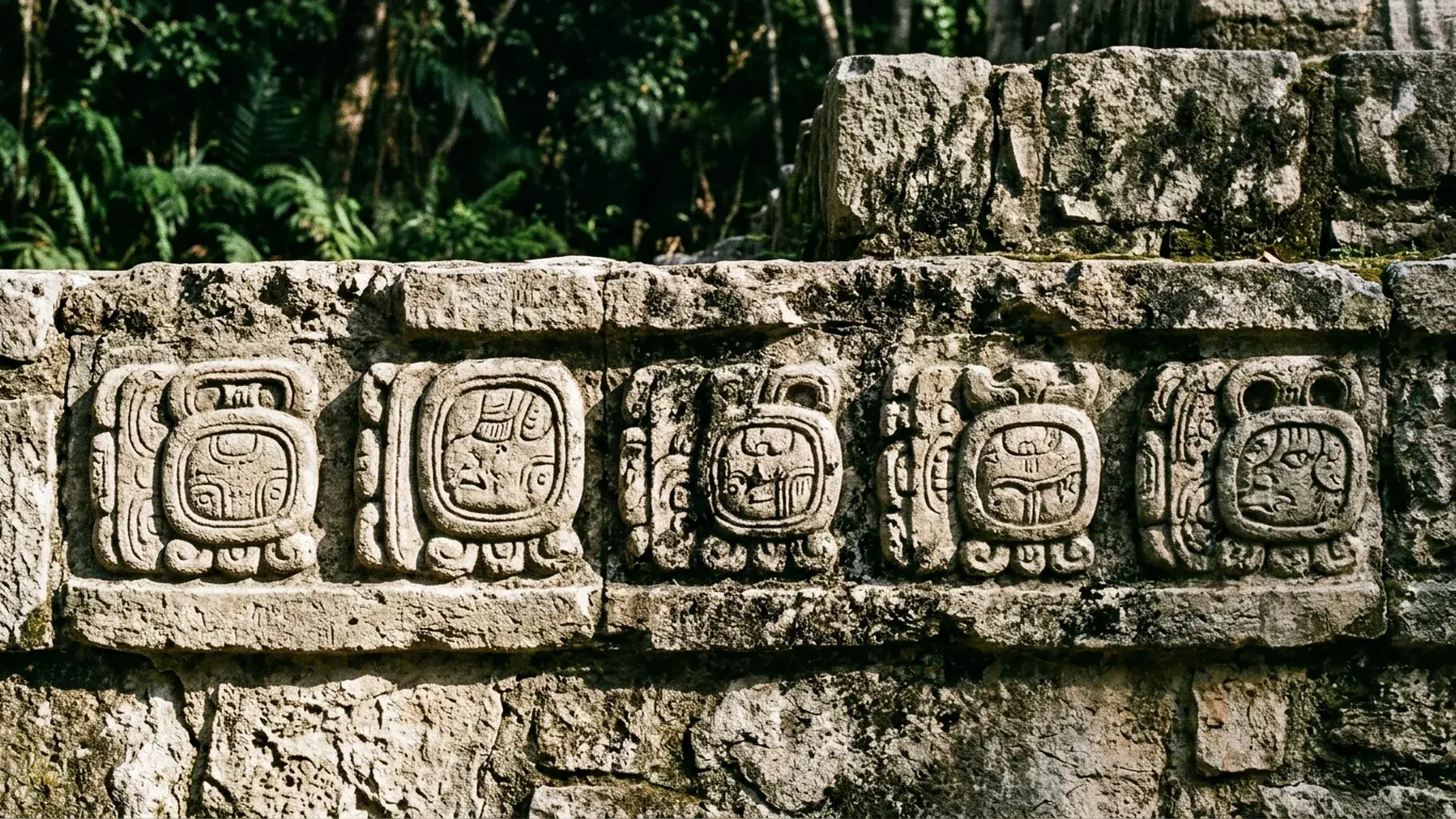
Composed of 20 day signs (Nawales) intermeshing with 13 numbers (tones). Because 20 and 13 share no common factors, the sequence produces 260 unique day designations (13 × 20 = 260).
Haab' (365-Day Solar Civil Calendar)
Composed of 18 regular months of 20 days each, plus a final 5-day month called Wayeb' (18 × 20 + 5 = 365 days).
Calendar Round (52-Year Cycle)
The combination of a Tzolk'in date and a Haab' date repeats every 18,980 days (exactly 52 Haab' solar years or 73 Tzolk'in cycles).
Long Count (Base-20 Linear Count)
A continuous count of days elapsed since the creation epoch date 13.0.0.0.0 (4 Ajaw 8 Kumk'u). Expressed in Bak'tun (144,000 days), K'atun (7,200 days), Tun (360 days), Winal (20 days), and K'in (1 day).
3. Correlation Constant: GMT 584283
To map Gregorian calendar dates to the Maya Long Count, a correlation constant is required. OmniZodiac standardizes on the GMT (Goodman-Martínez-Thompson) 584283 correlation constant.
The GMT 584283 correlation is strongly supported by multiple independent lines of scholarly evidence:
- Living K'iche' Daykeeping Continuity: Ethnographic research by Barbara Tedlock (1982/1992) confirmed that the continuous 260-day ritual count kept by Highland Maya daykeepers (Ajq'ijab') in Momostenango and adjacent communities directly aligns with 584283.
- Radiocarbon Validation: Kennett et al. (2013) in Scientific Reports performed high-precision AMS 14C dating and annual-growth wiggle-matching on carved wooden lintels from Tikal Temple IV, constraining dates to AD 658–696 and strongly supporting the GMT correlation within 95% confidence intervals.
- Colonial Astronomical Records: Fray Diego de Landa's Relación de las Cosas de Yucatán (1566) documented 12 Kan 1 Pop corresponding to July 16, 1566 (Julian), mapping directly to 584283.
- Epigraphic Consensus: Major studies by Thompson (1950) and Lounsbury (1983) endorse 584283 for Classic Maya inscriptions.
Exclusion of Dreamspell
4. Mathematical Conversion Formulas
OmniZodiac converts input dates to Julian Day Numbers (JDN) using the standard Meeus / Fliegel-Van Flandern algorithm:
If month ≤ 2: year = year - 1, month = month + 12
A = floor(year / 100)
B = 2 - A + floor(A / 4)
JDN = floor(365.25 × (year + 4716)) + floor(30.6001 × (month + 1)) + day + B - 1524.5
Integer JDN = floor(JDN + 0.5)
Tzolk'in Calculation Formulas
Using `daysSinceCreation = JDN_integer - 584283`:
signIndex = ((daysSinceCreation % 20) + 19) % 20   → Maps to day sign array (0-19)
toneIndex = ((daysSinceCreation % 13) + 3) % 13 + 1 → Yields tone number (1-13)
5. Academic Sources & Bibliography
- Thompson, J.E.S. (1950). Maya Hieroglyphic Writing: An Introduction. Carnegie Institution of Washington.
- Lounsbury, F.G. (1983). "The Base of the Venus Table of the Dresden Codex". Calendars in Mesoamerica and Peru.
- Tedlock, B. (1982/1992). Time and the Highland Maya. University of New Mexico Press.
- Kennett, D.J. et al. (2013). "Correlating the ancient Maya and modern European calendars with high-precision AMS 14C dating". Scientific Reports, 3, 1597.