

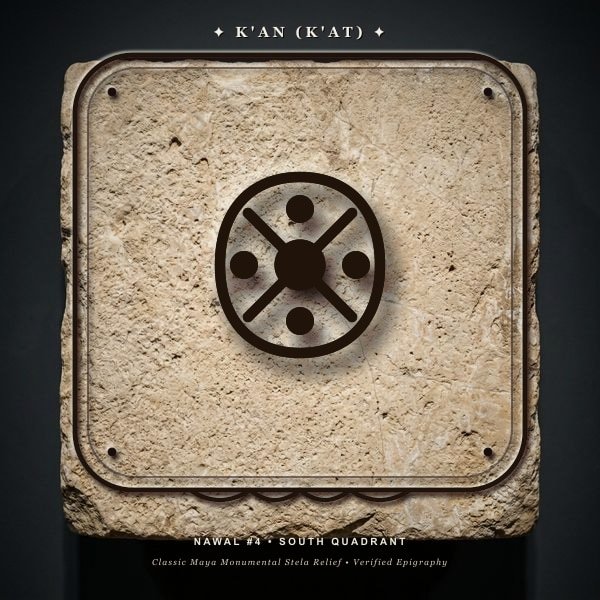
✦ Verified Classic Epigraphy ▾
Carved bas-relief visualization grounded in Classic Maya monumental stone inscriptions and Postclassic screenfold codices. Mathematical vector geometry preserved without AI distortion or pseudo-glyph fabrication.
✦ RESEARCH & EPIGRAPHIC SOURCES DOSSIER ✦ →K'an (K'at)
Embodying the sacred spirit of seed, net, abundance, aligned with the south direction in the sacred 260-day Tzolk'in count.
K'an (K'at) Epigraphic Provenance Record
Scholarly epigraphic morphology, hieroglyphic decipherment concordances, and archaeological occurrences from monumental inscriptions and pre-Columbian codices.
Epigraphic Taxonomy
- Thompson Catalog
T506- Logographic Value
K'AN (Precious Maize / Germinating Seed / Abundance)- Phonetic Reading
k'a-na- Classic Monuments
- Copán Altar Q; Quiriguá Stela E; Tikal Stela 31
- Screenfold Codices
- Dresden Codex, pp. 33b–35b; Madrid Codex, pp. 24–28
Glyph Morphology & Diagnostics
Germinating ripe maize kernel cartouche, diagonal knotted net lattice of abundance, and 4 cardinal seed nodules.
Epigraphic & Cosmological Taxonomy
Archaeological classification, epigraphic morphology, and quadripartite cosmology grounded in Classic monumental inscriptions.
Linguistic & Nawal Identity
- Yukatek Maya
- K'an
- Highland K'iche'
- K'at
- Archetypal Symbolism
- Seed, Net, Abundance
- Popol Vuh Concordance
- Sacred Cholq'ij Daykeeper Tradition
Quadripartite Cosmology
- Cardinal Direction
- South (Nojol)
- Ceremonial Pigment
- K'an (Yellow Ochre / Maize)
- Mesoamerican Element
- Water & Abundance
- World Tree Quarter
- South World-Tree · Ripening, Harvest & Earth Vitality
Hieroglyphic Morphology & Inscription Registers
- Monumental Relief Inscriptions
- Copán Altar Q; Quiriguá Stela E; Tikal Stela 31
- Screenfold Codex Occurrences
- Dresden Codex, pp. 33b–35b; Madrid Codex, pp. 24–28
- Diagnostic Visual Traits
- Germinating ripe maize kernel cartouche, diagonal knotted net lattice of abundance, and 4 cardinal seed nodules.
- Scholarly Thompson Concordance
- Eric Thompson (1950) Maya Hieroglyphic Writing
✦ RESEARCH & EPIGRAPHIC SOURCES DOSSIER ✦
Germinating ripe maize kernel cartouche, diagonal knotted net lattice of abundance, and 4 cardinal seed nodules.
Copán Altar Q; Quiriguá Stela E; Tikal Stela 31
Dresden Codex, pp. 33b–35b; Madrid Codex, pp. 24–28
K’an is the fourth day sign of the Tzolk’in calendar, symbolizing the ripe seed, maize, net, and potential for growth. It represents inner wealth, abundance, and organic discipline required to cultivate life’s harvest.
Nawal Qualities
- Germinating Seed: Encapsulates latent potential, fertility, and stored energy ready to bloom.
- Structure & Net: Symbolizes the mesh or net that gathers resources, knowledge, and community.
- Nutritional Abundance: Linked to maize, sustenance, and patient cultivation.
Direction & Color
Associated with the South (Nojol) and the color yellow (K’an). The South represents warmth, ripening crops, maturity, and earthly abundance.
K’iche’ Correspondence
In the Highland K’iche’ Cholq’ij, K’an corresponds to K’at. While Yukatek K’an focuses on seed abundance, K’iche’ K’at emphasizes the net, gathering, binding, and releasing entanglements.
Modern Reflection
Confidence Level: Modern Interpretation
Modern interpretive commentary views K’an as a symbol for intentional goal-setting and nurturing personal growth. It prompts reflection on what seeds of intention one is planting and watering in daily life.
In personal development contexts, K’an serves as an archetype of patience and organic timing. It reminds individuals that meaningful achievements require time, preparation, and proper conditions.
Sources & Further Reading
Grounded in Mesoamerican agricultural ritual studies by Karl Taube and Highland Guatemalan ethnographic accounts by Dennis Tedlock.
Monumental Inscriptions & Epigraphic Provenance
How K'an was carved into Classic Maya stone stelae and painted in hieroglyphic screenfold codices.
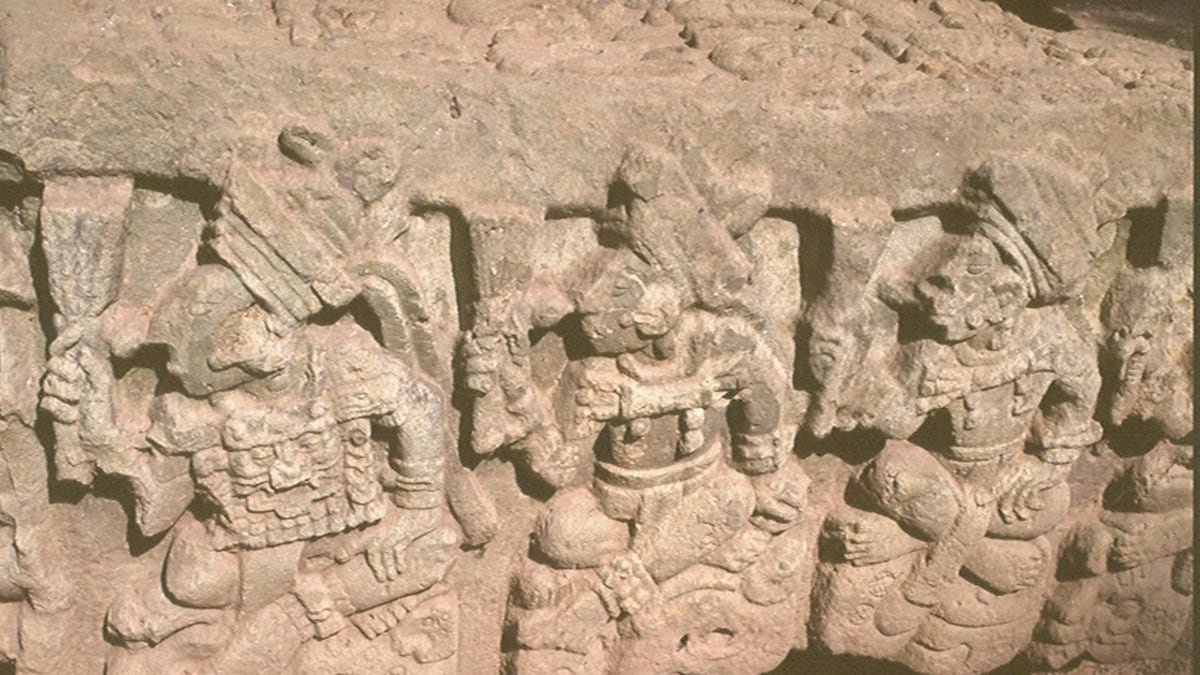
Epigraphic Field Analysis
K'an signifies the germinating maize kernel and knotted net of abundance, carved in royal accession stelae celebrating agricultural prosperity and seasonal continuity.
Copán & Tikal · Monumental Stelae & Altars
5-Tier Epistemological Truth Standard
Explore the primary artifacts, peer-reviewed monographs, astronomical ephemerides, and living tradition ethnography behind this page.
Calculated Astronomical Fact
Continuous integer modulo arithmetic converts civil dates to Julian Day Numbers (Meeus/Fliegel-Van Flandern) with the GMT 584,283 correlation constant, deterministically yielding Nawal index (0–19) and sacred Tone (1–13).
Primary Historical Evidence
- Dresden Codex Hieroglyphic Screenfold Manuscript (pp. 46–58 Venus & Eclipse Tables)
- Quiriguá Stela C Creation Inscription (13.0.0.0.0 4 Ajaw 8 Kumkʼu)
- Monumental Classic Stone Inscriptions (Nawal K'an)
- Copán Structure 16 Altar Q Dynastic Register
Scholarly Academic Interpretation
Goodman-Martínez-Thompson (GMT 584283) correlation consensus (Thompson 1950, Lounsbury 1983) strongly supported by high-resolution AMS radiocarbon dating on carved sapodilla lintels within 95% confidence intervals (Kennett et al. 2013, Scientific Reports).
Living Indigenous Tradition
Active Living Tradition: Maintained through continuous communal cultural lineage and living practice.Living ritual daykeeping documented among contemporary Highland Kʼicheʼ Ajqʼijabʼ in Momostenango and adjacent communities (Barbara Tedlock 1982/1992).
Modern OmniZodiac Interpretation
Introspective archetypal reflection exploring the symbolic harmony of Nawales and Tones for personal self-awareness, strictly free of fatalistic prediction.
Calculate Your Maya Birth Sign
Find out if K'an is your birth Nawal using your date of birth and the GMT 584283 scholarly correlation model.
Classic Maya Tzolk'in Exploration
Continue your sacred calendar journey through Highland K'iche' traditions and Kennett GMT 584283 astronomy.

Calculate Your Maya Day Sign
Find your natal Nawal, sacred numeral (1–13), and trecena directional patron.
