
Decan Specifications
ẖr-ẖnmw / ẖnmw (smꜣ) Historical Nilotic Star Clock & Source
Dendera Circular Zodiac & Hellenistic Graeco-Egyptian (EAT III Table 5; Hephaestio 1.1; Liber Hermetis 25)

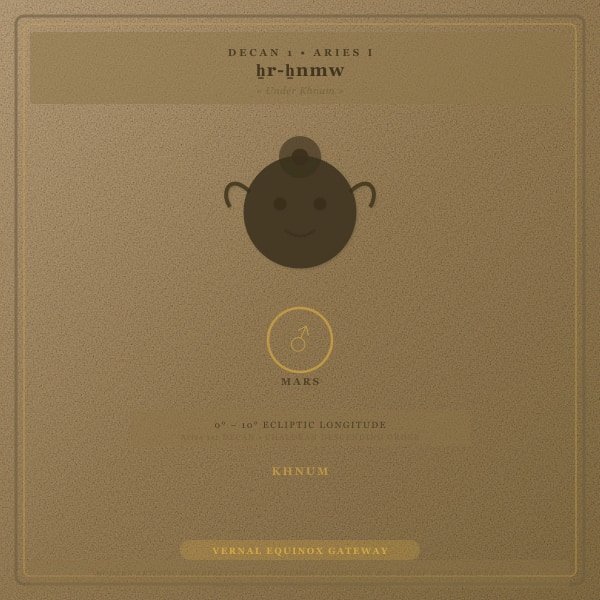
ẖr-ẖnmw / ẖnmw (smꜣ)
« Under Khnum / The Ram God Khnum (The Joiner / Uniter) » Dendera Circular Zodiac & Hellenistic Graeco-Egyptian (EAT III Table 5; Hephaestio 1.1; Liber Hermetis 25)
Neugebauer & Parker (1969) EAT III Table 5 p. 62; Hephaestio of Thebes Apotelesmatics 1.1 (Pingree 1973); von Bomhard (2008)
In Hephaestio: Charchnoumis (Χαρχνουμίς). Liber Hermetis: Charchnoumis. Dendera Circular Zodiac depicts ram-headed standing decan. Tanis papyrus lists smꜣ. Historically distinct from Kenmet.
Modern Calculation — Artifact-Inspired
Hellenistic 10° Ecliptic Arc — Aries (0° – 10°)
Mathematical Alexandrian model of the 360° tropical ecliptic. Not an excavated Pharaonic object.
Mars (♂)
Chaldean Order Cycle: Step 1 of 7 in the classical descending planetary sphere sequence.
Decan 1 marks the beginning of the 36-decan cycle, initiating the tropical solar year at the vernal equinox (0° Aries). Representing the raw emergence of vital force, this initial ten-degree division sets the tone for active movement and pioneering momentum.
Historical Context
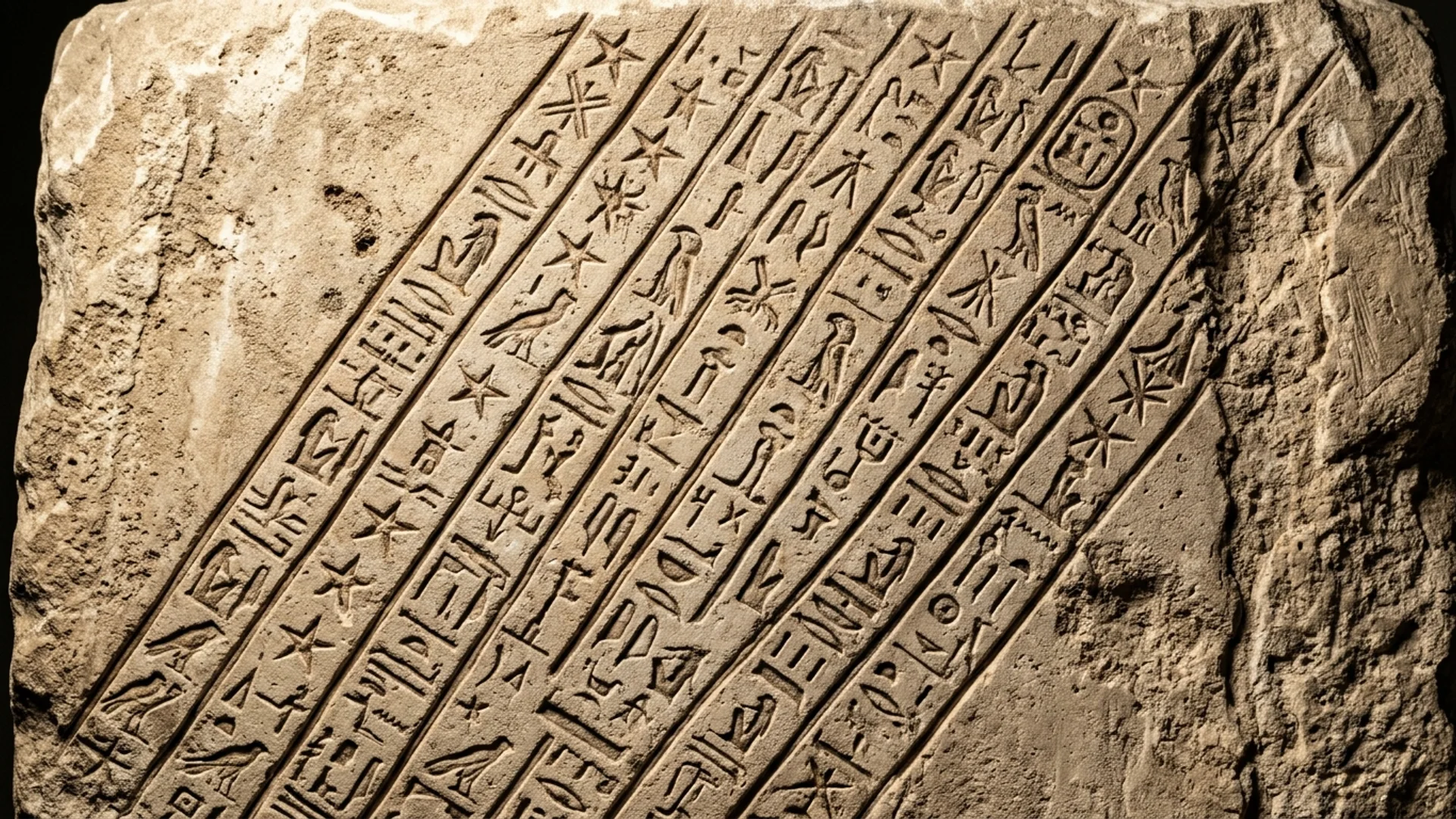
In ancient Egypt, decans originated as a system of 36 asterisms (baktiu) observed rising heliacally before dawn across 10-day intervals (decades) to measure the nocturnal hours and agricultural seasons. In the documented Hellenistic-Egyptian tradition (Dendera circular planisphere, Hephaestio of Thebes 1.1, and Liber Hermetis 25), this sector is identified as ẖr-ẖnmw / ẖnmw (smꜣ) (“Under Khnum / The Ram God Khnum (or The Joiner / Uniter)”).
In Hephaestio: Charchnoumis (Χαρχνουμίς). Liber Hermetis: Charchnoumis. Dendera Circular Zodiac depicts ram-headed standing decan. Tanis papyrus lists smꜣ. Often confused in modern literature with Kenmet. Scholarly documentation: Neugebauer & Parker (1969) EAT III Table 5 p. 62; Hephaestio of Thebes Apotelesmatics 1.1 (Pingree 1973); von Bomhard (2008).
Zodiacal Association
Following the synthesis of Egyptian star lore and Babylonian sign geometry during the Alexandrian period, this segment was mapped as the Hellenistic-Egyptian Zodiac Context for 0°–10° Aries. It combines cardinal fire energy with the primary impulse of physical manifestation and raw initiative.
Chaldean Ruler: Mars
Under the traditional Chaldean ordering, Mars rules this opening decan, doubling the martial quality of Aries. This alignment emphasizes direct action, courageous impulse, and decisive force without hesitation.
Modern Interpretation
Contemporary astrological traditions associate this placement with pioneering enthusiasm, high physical vitality, and an instinctive drive to overcome obstacles. In Modern Popular Interpretation, individuals born under this decan are often viewed as self-starters who thrive in competitive environments and prefer immediate action over protracted contemplation.
Astrologers emphasize that these Modern Popular Interpretation personality descriptions represent modern archetypal frameworks rather than ancient Egyptian predictive omens. This characterization serves as a psychological model for self-directed personal growth and energetic initiative.
Decan 1: ẖr-ẖnmw / ẖnmw (smꜣ) Epigraphic Register
Documented philological transliterations, Hellenistic Greek transcriptions, Ptolemaic zodiac sector bounds, and Chaldean planetary governance.
Ancient Nilotic Epigraphy
- Transliteration
ẖr-ẖnmw / ẖnmw (smꜣ)- Documented Meaning
- « Under Khnum / The Ram God Khnum (The Joiner / Uniter) »
- Stellar Asterism Family
- Khnum (The Creator / Ram-Headed Astral Guardian)
- Primary Epigraphic List
- Dendera Circular Zodiac & Hellenistic Graeco-Egyptian (EAT III Table 5; Hephaestio 1.1; Liber Hermetis 25)
Hellenistic Alexandria Synthesis
- Zodiac Sign & Face
- 1st (0°–10°) Aries
- Ecliptic Longitude Arc
0.00° – 10.00°- Hellenistic Sector Name
- Aries 0°–10° (0°–10° ecliptic longitude)
- Cardinal Gateway
- ✦ Vernal Equinox Gateway (0° Tropical Aries)
Chaldean Planetary Governor
- Planetary Governor
- ♂ Mars
- Planetary Speed Order
- Saturn → Jupiter → Mars → Sun → Venus → Mercury → Moon
- Material Basis
- Ptolemaic Sandstone Bas-Relief with Gold Leaf
- Representative Plate
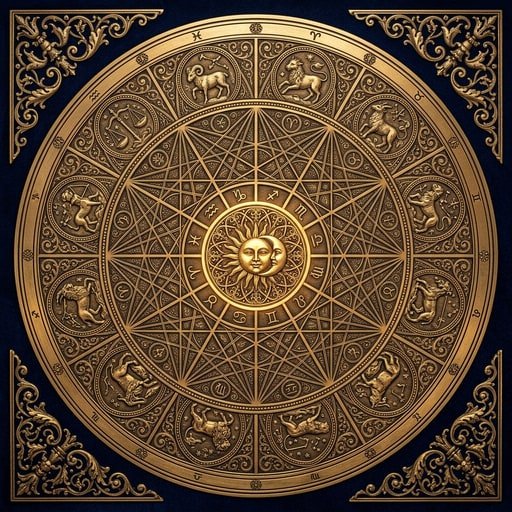
- Dendera Circular Planisphere Sandstone Ceiling Relief (Musée du Louvre, Inv. D 38, c. 50 BCE)
1-Click Citation Export
Standard formatted academic citations for research publications, peer-reviewed bibliographies, and scholarly reference.
5-Tier Epistemological Truth Standard
Explore the primary artifacts, peer-reviewed monographs, astronomical ephemerides, and living tradition ethnography behind this page.
Calculated Astronomical Fact
Continuous analytical VSOP87 solar ecliptic longitude partitioning the 360° tropical zodiac into thirty-six 10° decanal arcs, resolved to ~1 arcminute physical precision.
Primary Historical Evidence
- Asyut Necropolis coffin lid diagonal star tables (c. 2100 BCE, Middle Kingdom)
- Tomb of Senenmut TT353 astronomical ceiling (c. 1473 BCE, 18th Dynasty)
- Dendera Temple of Hathor circular zodiac bas-relief (Louvre D 38, c. 50 BCE)
Scholarly Academic Interpretation
Neugebauer & Parker (1960–1969) Egyptian Astronomical Texts (Vols. I–III) and von Bomhard (2008) Naos of the Decades epigraphic analysis.
Living Indigenous Tradition
Historical Archival Tradition: Temple liturgy ceased in antiquity; reconstructed from primary documentary texts.Historical archival tradition: Temple liturgical ceremonies ceased in late antiquity; reconstructed from primary hieroglyphic star clocks and Hellenistic papyri.
Modern OmniZodiac Interpretation
Chaldean planetary ruler dignities, seasonal stellar motifs, and contemplative decanal themes; separated from ancient funerary omenology.
Explore Decan 1 Connections
Discover which of the 36 sacred Egyptian decans governs your precise birth date and planetary degree.
Pharaonic 36-Decan Star Map
Deepen your relationship with Egyptian decanal astronomy, Chaldean rulers, and temple ceilings.

Calculate Your Egyptian Decan
Identify your natal EAT III star-clock asterism, solar degree, and 10° Chaldean ruler.

Scholarly Variant Readings & Philological Commentary
In Hephaestio: Charchnoumis (Χαρχνουμίς). Liber Hermetis: Charchnoumis. Dendera Circular Zodiac depicts ram-headed standing decan. Tanis papyrus lists smꜣ. Historically distinct from Kenmet.