

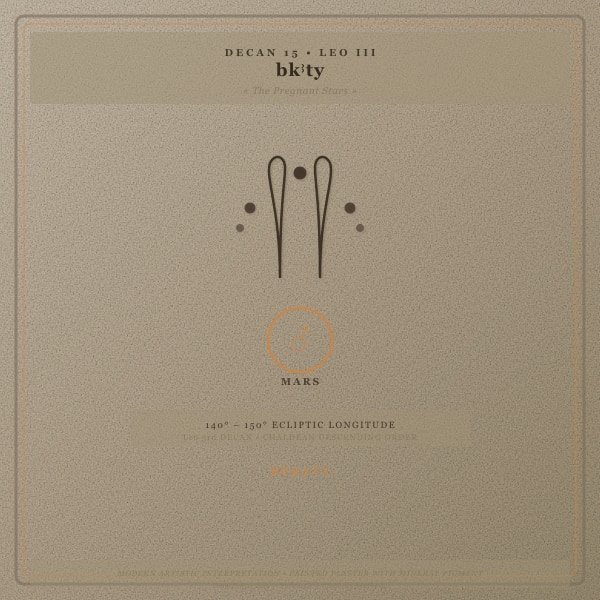
Historical Nilotic Star Clock & Source
Dendera Circular Zodiac & Hellenistic Graeco-Egyptian (EAT III Table 5; Hephaestio 1.1; Liber Hermetis 25)
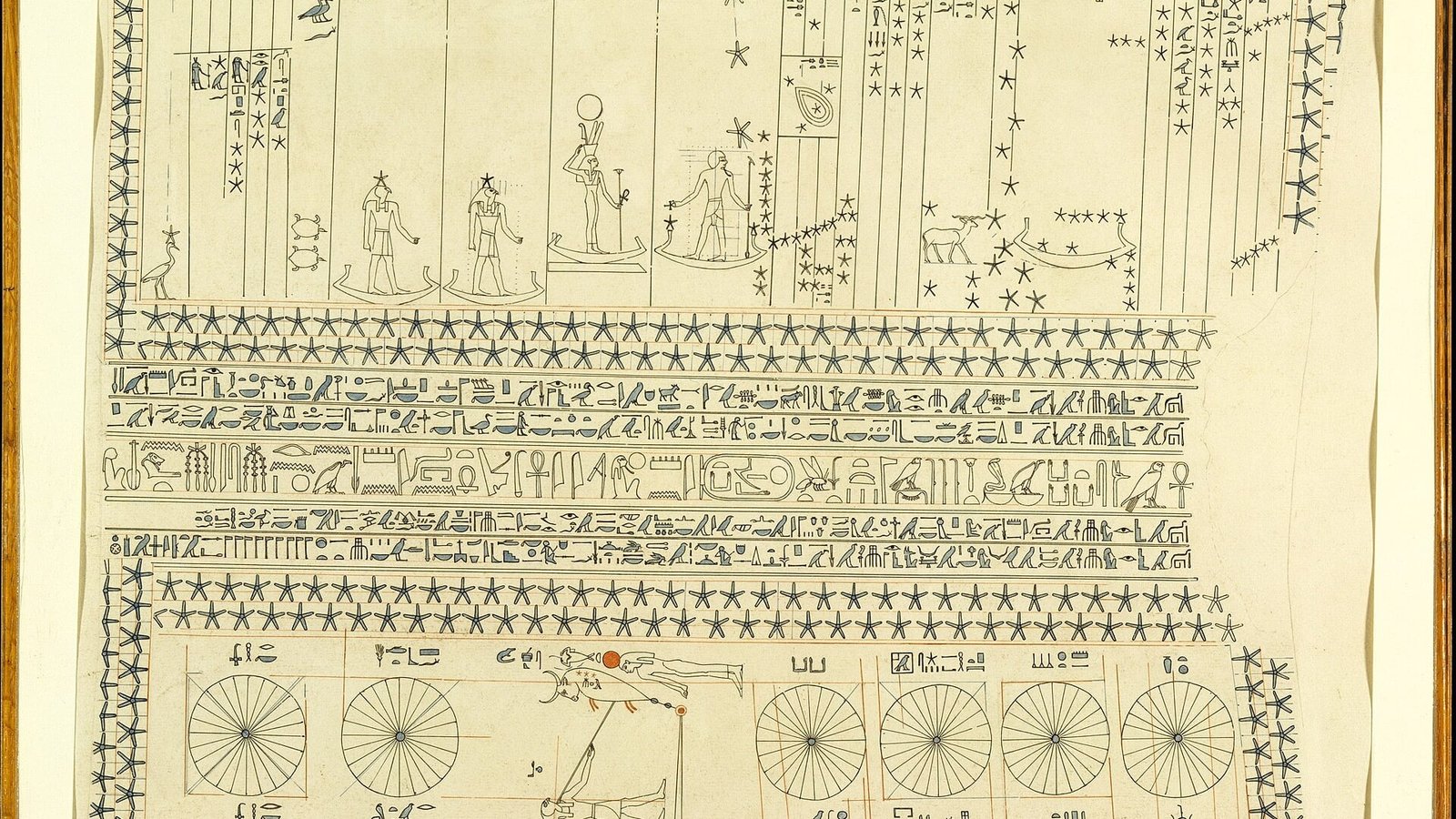
bkꜣty
« The Pregnant Stars / The Two Feathers » Dendera Circular Zodiac & Hellenistic Graeco-Egyptian (EAT III Table 5; Hephaestio 1.1; Liber Hermetis 25)
Neugebauer & Parker (1969) EAT III Table 5 p. 66; Hephaestio 1.1; Gundel (1936)
In Hephaestio: Ouphtē (Οὐφτή). Liber Hermetis: Bekan. Concludes the Leo decanic sector.
Modern Calculation — Artifact-Inspired
Hellenistic 10° Ecliptic Arc — Leo (140° – 150°)
Mathematical Alexandrian model of the 360° tropical ecliptic. Not an excavated Pharaonic object.
Mars (♂)
Chaldean Order Cycle: Step 1 of 7 in the classical descending planetary sphere sequence.
Decan Specifications
bkꜣty Decan 15 covers 140° to 150° of the ecliptic (20°–30° Leo), closing the sign of Leo in the decanal cycle. This decan merges creative solar warmth with fiery martial drive and courage.
Historical Context
In ancient Egypt, decans originated as a system of 36 asterisms (baktiu) observed rising heliacally before dawn across 10-day intervals (decades) to measure the nocturnal hours and agricultural seasons. In the documented Hellenistic-Egyptian tradition (Dendera circular planisphere, Hephaestio of Thebes 1.1, and Liber Hermetis 25), this sector is identified as bkꜣty (“The Pregnant Stars / The Two Feathers”).
In Hephaestio: Ouphtē (Οὐφτή). Liber Hermetis: Bekan. Concludes Leo. Scholarly documentation: Neugebauer & Parker (1969) EAT III Table 5 p. 66; Hephaestio 1.1; Gundel (1936).
Zodiacal Association
Under the Hellenistic-Egyptian Zodiac Context, 20°–30° Leo bridges fixed fire with upcoming mutable earth (Virgo), combining dynamic ambition with energetic determination.
Chaldean Ruler: Mars
Mars governs this decan in the Chaldean sequence, endowing Leo’s creative core with fierce determination, physical stamina, and competitive passion.
Modern Interpretation
Modern Popular Interpretation paints individuals with this decan placement as bold, courageous, and fiercely protective champions. They are seen as individuals who fight passionately for their convictions and projects.
Astrologers note that this character interpretation is a Modern Popular Interpretation model, completely separate from ancient Egyptian star-clock functions.
Decan 15: bkꜣty Epigraphic Register
Documented philological transliterations, Hellenistic Greek transcriptions, Ptolemaic zodiac sector bounds, and Chaldean planetary governance.
Ancient Nilotic Epigraphy
- Transliteration
bkꜣty- Documented Meaning
- « The Pregnant Stars / The Two Feathers »
- Stellar Asterism Family
- Bekaty (The Fecund Stars)
- Primary Epigraphic List
- Dendera Circular Zodiac & Hellenistic Graeco-Egyptian (EAT III Table 5; Hephaestio 1.1; Liber Hermetis 25)
Hellenistic Alexandria Synthesis
- Zodiac Sign & Face
- 3rd (20°–30°) Leo
- Ecliptic Longitude Arc
140.00° – 150.00°- Hellenistic Sector Name
- Leo 20°–30° (140°–150° ecliptic longitude)
Chaldean Planetary Governor
- Planetary Governor
- ♂ Mars
- Planetary Speed Order
- Saturn → Jupiter → Mars → Sun → Venus → Mercury → Moon
- Material Basis
- Painted Plaster with Mineral Pigment
- Representative Plate
- Senenmut Astronomical Ceiling South Panel (Metropolitan Museum of Art / TT353)
1-Click Citation Export
Standard formatted academic citations for research publications, peer-reviewed bibliographies, and scholarly reference.
5-Tier Epistemological Truth Standard
Explore the primary artifacts, peer-reviewed monographs, astronomical ephemerides, and living tradition ethnography behind this page.
Calculated Astronomical Fact
Continuous analytical VSOP87 solar ecliptic longitude partitioning the 360° tropical zodiac into thirty-six 10° decanal arcs, resolved to < 0.01° precision.
Primary Historical Evidence
- Asyut Necropolis coffin lid diagonal star tables (c. 2100 BCE, Middle Kingdom)
- Tomb of Senenmut TT353 astronomical ceiling (c. 1473 BCE, 18th Dynasty)
- Dendera Temple of Hathor circular zodiac bas-relief (Louvre D 38, c. 50 BCE)
Scholarly Academic Interpretation
Neugebauer & Parker (1960–1969) Egyptian Astronomical Texts (Vols. I–III) and von Bomhard (2008) Naos of the Decades epigraphic analysis.
Living Indigenous Tradition
Historical Archival Tradition: Temple liturgy ceased in antiquity; reconstructed from primary documentary texts.Historical archival tradition: Temple liturgical ceremonies ceased in late antiquity; reconstructed from primary hieroglyphic star clocks and Hellenistic papyri.
Modern OmniZodiac Interpretation
Chaldean planetary ruler dignities, deity archetypes, and contemplative decanal themes; separated from ancient funerary omenology.
Explore Decan 15 Connections
Discover which of the 36 sacred Egyptian decans governs your precise birth date and planetary degree.
Pharaonic 36-Decan Star Map
Deepen your relationship with Egyptian decanal astronomy, Chaldean rulers, and temple ceilings.

Calculate Your Egyptian Decan
Identify your natal decan netjer, star coordinate degree, and seasonal protection.

Scholarly Variant Readings & Philological Commentary
In Hephaestio: Ouphtē (Οὐφτή). Liber Hermetis: Bekan. Concludes the Leo decanic sector.